
Single-use bags or stainless steel vessels: when to choose each
Single-use bags or stainless steel vessels: cleaning and validation, cross-contamination, scale, costs and waste, and what to specify in a single-use bag.
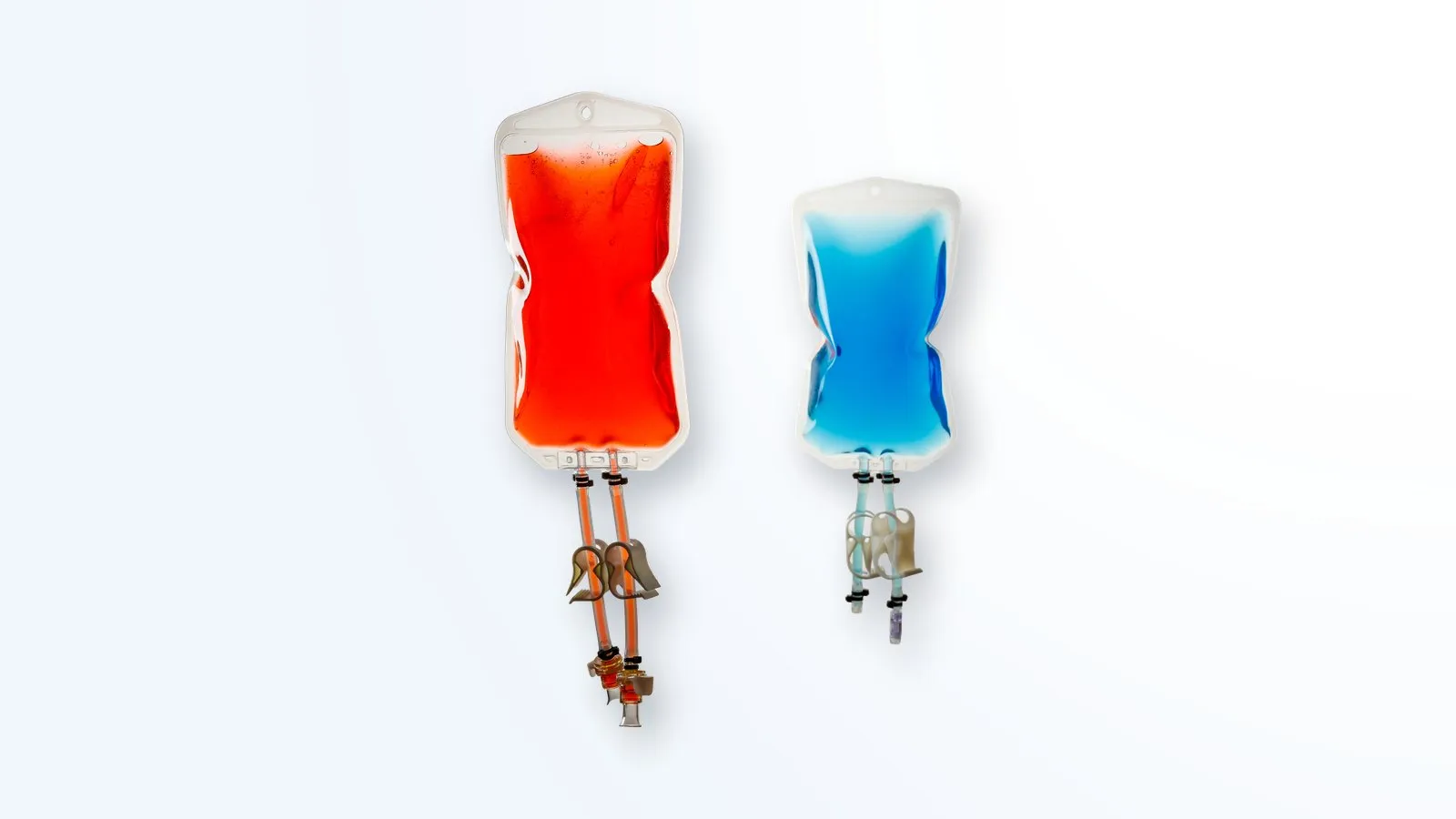
Single-use bags make sense when the plant works with several products or with small and medium batches, needs fast product changeovers, or wants to get rid of cleaning, and its validation, between batches. Stainless steel vessels make sense with large volumes of the same product, long campaigns, and a plant that already has clean-in-place and steam-in-place (CIP and SIP) systems and the utilities that feed them.
It is not an all-or-nothing choice. Many plants combine stainless steel in the highest-volume steps with single-use systems to prepare buffers and media, store intermediate solutions, or move them between areas. These are the criteria for deciding at each step.
What changes between a single-use bag and a stainless steel vessel
A stainless steel tank is used for years. Between one batch and the next it has to be cleaned, rinsed, and sterilized, and the cleaning has to be shown to work: validated CIP and SIP cycles, sampling for product and detergent residues, maximum dirty and clean hold times, and purified water, water for injection, and clean steam utilities to support all of it.
A single-use bag is used once and discarded. Each batch starts with a new bag, with no internal cleaning or steam sterilization between batches. Validation does not disappear; it shifts: instead of validating cleaning, you qualify the bag materials, its integrity, and the lot documentation supplied by the manufacturer.
The other change is mechanical. A steel tank can take knocks; a filled bag is a flexible container, and its risks are punctures, folds, and pulling on the tubing. That is why it is handled in trays, racks, or rigid containers, and its integrity is checked before use.
What you gain and what you pay with each option
| Criterion | Single-use bag | Stainless steel vessel |
|---|---|---|
| Between batches | The bag is replaced | Validated cleaning and sterilization (CIP and SIP) |
| Cross-contamination | New contact surface for every batch | Controlled through cleaning validation |
| Product changeover | Change the bag and connect | Clean, verify, and release the equipment |
| Initial investment | Lower | Higher: vessel, CIP, SIP, and utilities |
| Cost per batch | Bags, tubing, and connectors | Water, chemicals, steam, energy, and cleaning hours |
| Scale | Small and medium volumes | Large volumes |
| Waste | Plastic discarded with every batch | Cleaning effluents |
| Supply | Bag inventory and lead times | Spare parts and maintenance |
| Risk to assess | Extractables, leachables, and bag integrity | Cleaning residues and surface condition |
The economics depend above all on changeover frequency. A multiproduct plant that cleans and validates often recovers the cost of the bags quickly. A dedicated line that makes the same product for weeks gets more out of the investment in steel.
Waste does not fall on one side only, either. The bag adds discarded plastic with every batch; steel adds detergent-laden effluents plus the water and energy consumed by cleaning and steam. A fair comparison is made per batch produced, using the plant’s actual volumes and changeover frequency.
When stainless steel is the better choice
- Large volumes of the same product, in long campaigns, with the equipment in use much of the time.
- Processes with pressure or temperature beyond what a plastic film can handle, or that need to be steam sterilized in place.
- Plants with CIP and SIP already validated, where the cost of cleaning is already absorbed.
When a single-use bag is the better choice
- Multiproduct facilities, where every product changeover on steel equipment requires cleaning, verification, and release.
- Process development and clinical trials, with small batches and changing formulations.
- Highly toxic drugs: the bag is discarded with the residue, and the operator does not have to clean a contaminated vessel.
- Vaccines, injectables, culture media, buffers, and process solutions, from 50 mL to 50 L with 2D bags and in larger volumes with 3D bags in a container.
In pharmaceutical and biotech plants it is common to combine both: steel for high-volume production and single-use around it, in preparation, intermediate storage, sampling, and transport.
2D bags and 3D bags in a container: how they differ
A 2D bag is flat, pillow-style: it is filled and laid on a tray or hung. It is the format for small volumes. The ExoFlex 2D Cerrada bag ranges from 50 mL to 50 L: from 50 to 500 mL with two polyethylene ports, and from 1 to 50 L with three boat-type ports. For handling there are storage trays and racks, rigid transport containers, and carts.
A 3D bag has its own volume—cubic or cylindrical—and needs a rigid container to support it when full. That is the role of the AgileReact containers: AISI 304, for 3D single-use bags of 50, 100, 200, 500, 1,000, and 2,000 L. The 50 to 1,000 L units have heavy-duty casters and can be stacked; the 2,000 L unit is a fixed installation, for high-volume processes integrated into the line. Front slots let you see the fill level, and the bottom tray, door, and top lid are selected in the code.
The practical boundary between the two formats is handling. As long as the filled bag can rest on a tray and be moved on a cart, a 2D bag is enough; when the volume grows, you need a 3D bag and a container to support it. In Exova’s range that boundary is at 50 L: it is the largest ExoFlex 2D bag and the smallest AgileReact container.
The container is made of stainless steel, but it does not touch the product: the bag contains it. That is why AISI 304 is enough, as we explain in AISI 304 vs. 316L stainless steel.
What to specify in a single-use bag
A bag is defined by five things. In ExoFlex 2D, the volume, tubing, and connectors are fields in the ordering code, and the film is the same for all of them.
- Volume and number of ports. 50, 100, 250, and 500 mL with two ports; 1, 5, 10, 20, and 50 L with three.
- Film. Five layers: a 233 µm ultra-low-density polyethylene (ULDPE) contact layer, a 28 µm EVOH gas barrier, and a 32 µm high-density polyethylene (HDPE) outer layer, bonded by two 21 µm adhesive layers. The contact layer defines compatibility with the fluid; the EVOH barrier limits the passage of oxygen and carbon dioxide, which matters for solutions sensitive to oxidation or to pH.
- Tubing. Platinum-cured silicone for product transfer, platinum-cured silicone suitable for peristaltic pumps, or TPE, which can be welded or sealed. Inner diameter: 1/8″ on the 50 to 500 mL bags; 1/4″ and 1/8″ on the 1 L bag; and 3/8″ and 1/8″ from 5 to 50 L.
- Connectors. 1½″ clamp with clamp, gasket, and end cap; luer lock with plug; male/female quick connector with cap; and needleless sampling port for syringes.
- Delivery condition and conditions of use. If the process requires a sterile system, specify the sterilization method and the documentation that supports it; the same goes for the use temperature, storage, and shelf life.
What quality documentation to request
With no cleaning to validate, confidence in the system rests on what the manufacturer documents. For ExoFlex 2D, this is what is declared:
- Biological reactivity per USP <88>: the material passed the in vivo tests with no significant adverse reactions and meets the criteria for Class VI plastics.
- Manufactured in an ISO 7 cleanroom: the bags and systems are designed, manufactured, and assembled in Argentina.
- Bag integrity tested at the plant.
- Traceability: a distinct lot number and a quality certificate for each lot.
- Validation guide available.
When each lot arrives, check the quality certificate against the lot number on the bags and record that number in the production batch record: this is what makes it possible to trace a deviation back to the component.
It is up to the user to assess the risk of extractables and leachables for their product and to qualify the system in their process. If the solution passes through a sterilizing-grade filter before it enters the bag, that filter and its integrity test are also part of the system; we explain this in 0.2 µm sterilizing filtration.
How we help you define the system
We configure each ExoFlex system for the process—volume, ports, tubing, and connectors—and the AgileReact containers in the capacity and with the options required. Send us the volume, the fluid, and the use in your process, and we will put together a proposal.
Frequently asked questions
Can an ExoFlex bag be connected to a stainless steel line?
Yes. The standard 1 to 50 L configurations are offered with a 1½″ clamp connection on one or two of their ports, which mates with a clamp connection on the installation. These combinations are offered with platinum-cured silicone or TPE tubing.
Can non-standard configurations be ordered?
Yes. Each model can be configured with other combinations of tubing, lengths, connectors, and sampling ports. The selection chart in the catalog also includes a disc-type port and bags with one or four ports, which are available on request.
What is the door latch on the AgileReact container for?
It prevents the door from opening accidentally if the 3D bag inflates during filling or use. This maintains product containment and protects the personnel working next to the container.


