
When to change a filter cartridge: differential pressure and service life
When to change a filter cartridge based on differential pressure: what ΔP measures, clean and change-out ΔP, warning signs, and how to log it batch by batch.
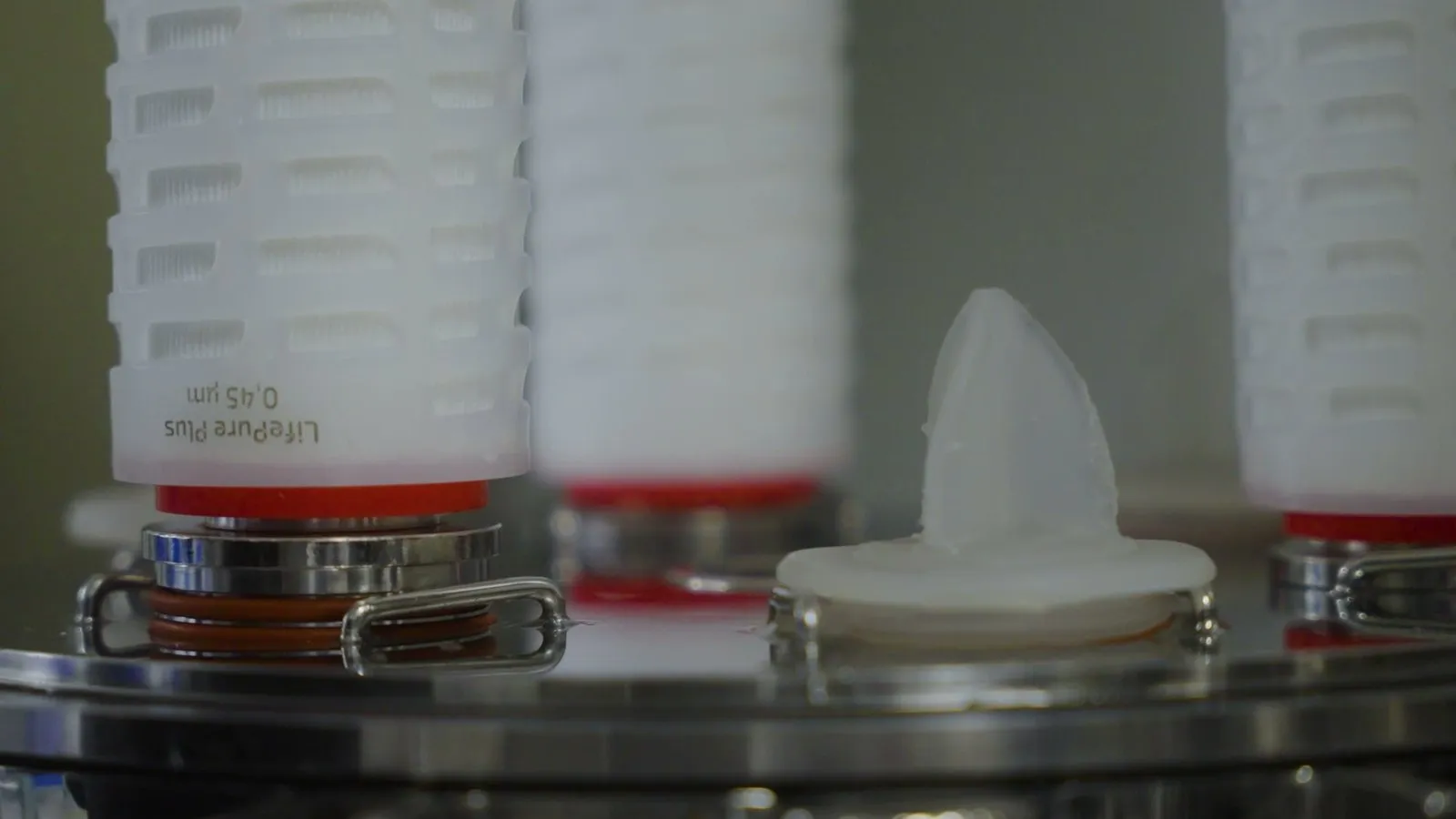
A filter cartridge should be changed when the differential pressure (ΔP) between the housing inlet and outlet reaches the change-out value stated in its catalog, not on a calendar basis or when the flow rate is no longer sufficient. For ProFlow, PreFiber, and LifePure cartridges, that value is 2 bar. ΔP is the direct measure of how clogged the medium is: it rises as the cartridge retains solids, and its trend also shows whether something is wrong with the installation.
Changing too early wastes cartridges; changing too late puts the cartridge, the product, and the next stage at risk. This article explains what a filter’s differential pressure measures, how to read it, and how to use it to decide when to change a filter cartridge.
What a filter’s differential pressure measures
Differential pressure is the difference between the pressure upstream and the pressure downstream of the filter. It is the energy the fluid loses as it passes through the filter medium, the cartridge, and the housing.
There are two ways to measure it:
- Two pressure gauges, one at the inlet and one at the outlet of the housing. ΔP is the difference between the two readings. This is the simplest option, but when the difference is small compared to the line pressure, the error of each gauge becomes significant.
- A differential pressure transmitter, which measures the difference directly and can send the signal to a control system or a data log.
In a filtration skid, ΔP measurement is planned at the design stage. The sanitary skids we custom-design with housings such as the SaniFlow STU-01 include ΔP measurement, along with drains at the low points and vents at the high points.
Clean ΔP: the baseline worth recording
With a new cartridge, the differential pressure is not zero. This clean ΔP depends on three things:
- Flow rate. In laminar flow, the pressure drop across a porous medium increases in proportion to the flow rate (Darcy’s law): twice the flow gives roughly twice the ΔP.
- Fluid viscosity. A syrup, a wine, or a protein solution gives a higher ΔP than water at the same flow rate. Since viscosity decreases with temperature, the same fluid gives a different ΔP when cold than when hot.
- The cartridge. Its rating, medium, and filtration area. At the same rating, more area spreads the flow and lowers ΔP: the ProFlow Plus, for example, has 8,000 cm² of filtration area per 10″.
That is why the clean ΔP is recorded every time new cartridges are installed, together with the flow rate and temperature at that moment. It is the baseline against which everything else is compared. A reading without the flow rate next to it says little: if the line flow drops, ΔP drops even though the cartridge is just as loaded.
The cartridge design also shifts that starting point. Dual-layer ProFlow cartridges, such as the ProFlow Protec, combine a prefilter layer and a final layer in the same element: they start with a higher clean ΔP, but take longer and process more volume before reaching the change-out differential pressure.
How differential pressure rises: surface and depth clogging
As the cartridge retains contaminants, the open area available for the fluid shrinks. If the flow rate is held constant, the differential pressure rises. The shape of the curve depends on where the retained material builds up.
Depth clogging
Depth media, such as the progressive-porosity polypropylene of ProFlow cartridges or glass microfiber, trap particles throughout their thickness. ΔP rises gradually for much of the cartridge’s life, because the particles are distributed through the volume of the medium. Near the end, when the medium has no more room, the rise speeds up.
Surface clogging
A membrane retains on its surface. Particles block pores and form a layer (the “cake”) that also filters and adds resistance. With a heavily loaded fluid, a membrane’s ΔP can go from stable to steep within a small volume. That is why a final membrane filter lasts much longer when an upstream stage removes the coarse load, as we explain in prefiltration: how to protect the final filter.
Hybrid cartridges combine both behaviors. The PreFiber GF + PES places a high-capacity glass microfiber prefilter ahead of an asymmetric PES membrane, in the same cartridge: the glass takes the load and the membrane works longer before it clogs.
When to change a filter cartridge: change-out ΔP and maximum ΔP
A cartridge catalog usually gives two different values, and they should not be confused:
- Change-out ΔP: the point at which replacing the cartridge is recommended. Beyond that value, each additional liter requires more pressure and the cartridge adds little filtered volume.
- Maximum ΔP: the mechanical limit the cartridge withstands without damage, in the forward direction. It is not an operating target.
On top of that comes the maximum ΔP in reverse flow, which is much lower: it is what the cartridge tolerates if the downstream pressure exceeds the upstream pressure (water hammer, a valve closing in the wrong sequence, a poorly executed drain-down).
| Model | Type | Change-out ΔP | Maximum ΔP (forward) | Maximum ΔP (reverse) |
|---|---|---|---|---|
| ProFlow Plus | Pleated polypropylene | 2 bar at most | 5.5 bar at 25 °C | 0.69 bar at 25 °C |
| ProFlow Protec | Dual-layer pleated polypropylene | 2 bar at most | 5.5 bar at 25 °C | 0.69 bar at 25 °C |
| PreFiber GF + PES | Glass microfiber + PES membrane | 2 bar (recommended) | 5.5 bar at 25 °C | 0.69 bar at 25 °C |
| LifePure Plus F&B | Asymmetric PES membrane | 2 bar at most | 5.5 bar at 25 °C | 0.69 bar at 25 °C |
The maximum values are stated at 25 °C. To operate at another temperature, use the value the manufacturer confirms for that condition.
In practice, the change-out criterion is built like this:
- Change at the catalog change-out ΔP, measured at the operating flow rate.
- Look at the whole train. If there is a prefilter and a final filter, each stage has its own ΔP. The goal is for both to reach their change-out point in comparable times; if one is changed much more often than the other, the staging of ratings needs to be reviewed.
- Respect the limits of the housing and the line. The cartridges’ ΔP is only part of the total pressure drop. The housing also has its own maximum operating pressure: 10 bar for the SaniFlow STU-01.
Differential pressure signals that are not clogging
ΔP is useful for more than deciding change-outs. Some patterns point to a problem that must be solved before you continue filtering:
- ΔP drops suddenly. At a constant flow rate, an unexplained drop in ΔP may mean the fluid is bypassing the medium: a damaged or poorly seated O-ring, a cartridge that does not fit the adapter, or a ruptured medium. Stop, check the assembly and, if it is a membrane filter, run the integrity test.
- The clean ΔP is higher than in the previous record. This may be a different flow rate or temperature, a cartridge of another rating, or air trapped in the housing. At start-up, the housing is vented through its high point so that the liquid reaches the whole cartridge and no filtration area is left unused.
- ΔP rises much faster than in previous batches. With the same product and the same cartridge, this usually signals a change in what is arriving: more solids, a batch with more colloids, or an upstream stage that has stopped retaining.
- There was reverse pressure. If the ΔP in the reverse direction exceeded the catalog maximum, the cartridge may have been damaged even if the forward reading looks normal.
On a final membrane filter, differential pressure and integrity are different things: a cartridge can have a low ΔP and not be integral. How integrity is verified is covered in integrity testing: bubble point and diffusive flow.
How to log ΔP per batch and estimate service life
A simple log turns ΔP into data for planning purchases and shutdowns. For each batch or shift, record:
- date, product, and batch;
- flow rate and temperature;
- ΔP at start and at end, per stage;
- volume filtered;
- sanitizations or cleanings performed and the ΔP after each one.
After a few batches, the log shows how many liters each stage processes before reaching its change-out ΔP with each product. That number is the cartridge’s real service life in that fluid and lets you calculate the cost per liter filtered.
When the process is sanitized, ΔP also helps you decide. The LifePure Plus F&B, for example, withstands multiple 30- to 60-minute cycles of steam at 121 °C or hot water at 80 °C, in single open-end cartridges. If after each sanitization the clean ΔP comes back higher than the previous time, the difference is the load that the cycle no longer removes: the cartridge is approaching change-out even if it does not yet reach 2 bar during the batch.
How we help you define the change-out criterion
We manufacture prefilter and membrane cartridges and sanitary filter housings in Argentina, and we design sanitary skids with ΔP measurement. Tell us what fluid you filter, at what flow rate, and how long each stage lasts today, and we will help you review the train and the change-out criterion. Send us your process data.
Frequently asked questions
Can I keep filtering up to the maximum differential pressure in the catalog?
It is not advisable. The maximum differential pressure is the cartridge's mechanical limit; the change-out pressure is the point at which it should be replaced. For the ProFlow Plus, for example, the maximum is 5.5 bar at 25 °C and change-out is at 2 bar at most. Going beyond that point adds little filtered volume and brings the element closer to its limit.
Is a membrane cartridge changed based on differential pressure alone?
Differential pressure tells you when the cartridge is clogged, not whether it is still integral. On a final membrane filter, the integrity test (bubble point or diffusive flow) confirms that the membrane retains what it must retain. If the test fails, the cartridge is changed even if its ΔP is low.
Does sanitizing a clogged cartridge restore its service life?
A sanitization or chemical cleaning can recover part of the differential pressure when what is clogging the cartridge dissolves or is flushed away, but it does not undo clogging by particles trapped in the medium. If the clean ΔP comes back higher after each cleaning cycle, the cartridge is reaching the end of its service life.


