

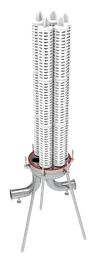
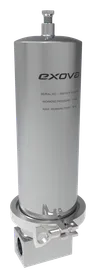

When to change a filter cartridge: differential pressure and service life
When to change a filter cartridge based on differential pressure: what ΔP measures, clean and change-out ΔP, warning signs, and how to log it batch by batch.

Industries
From the first coarse filtration to final filtration before bottling: mesh, polypropylene, glass microfiber, and membrane cartridges, and the housings to hold them, made in Argentina.
Filtering wine means spreading the load. Each stage removes something different—coarse solids, turbidity, colloids, yeasts, and bacteria—and protects the next one. The better the prefiltration works, the longer the final membrane lasts and the less each bottled liter costs.
Membrane cartridges for wineries (the LifePure and UltraPure F&B versions) are integrity tested at the plant and supplied with diffusive flow and bubble point values so the winery can test them again. They withstand hot water sanitization at 80 °C, chemical sanitization, and steam-in-place, so they are reused from one batch to the next.
Clarification with polypropylene or glass microfiber, a hybrid prefilter, and a final membrane: each stage protects the next.
The final membranes state retention > 10⁷/cm² of Saccharomyces cerevisiae at 0.65 µm and of Serratia marcescens at 0.45 µm.
Diffusive flow and bubble point values to test the wetted membrane before and after filtration.
Hot water at 80 °C, cleaning and disinfecting chemicals, and steam-in-place, according to each model's catalog.
Stage by stage
Pleated 304 stainless steel mesh, from 12 to 500 µm, that is washed and returned to the line. Heat-welded, adhesive-free, and suitable for contact with food and beverages.
Pleated polypropylene (absolute rating of 0.5 to 20 µm in the ProFlow Plus) and high-capacity glass microfiber for turbidity and colloids.
Hybrid prefilters—glass microfiber or polypropylene with a final PES membrane—and a 0.65 µm PES membrane for yeasts.
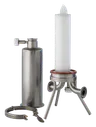 PreFiber GF + PESGlass microfiber + PES membrane cartridge PreFiber PP + PESDual-layer PP + PES membrane cartridge PreFiber Max GF + PESGlass microfiber + PES membrane cartridge PreFiber A PP + PESAbsolute-rated dual-layer PP + PES cartridge
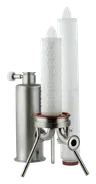 LifePure WPES membrane cartridge for beer and wine LifePure W GradedPES membrane cartridge for beer and wine
Microbial stabilization of wine and unpasteurized alcoholic beverages with PES or nylon 6,6 membranes.
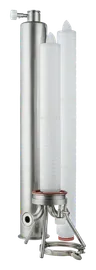
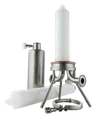
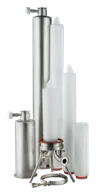
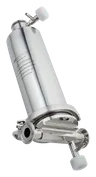
Single-cartridge or multi-element for 3 to 36 cartridges in AISI 304, and for a single double-open-end cartridge in AISI 316L.
Frequently asked questions
It depends on the wine, its load, and what you need to retain. As a reference, the LifePure and UltraPure catalogs state retention greater than 10⁷/cm² of Saccharomyces cerevisiae at 0.65 µm and of Serratia marcescens at 0.45 µm. We work it out with you based on the wine and the process.
With good prefiltration. Clarification with polypropylene or glass microfiber and a hybrid prefilter (PreFiber) ahead of the final membrane reduce the load reaching the membrane and extend its service life.
Yes. Membrane cartridges for wineries withstand hot water sanitization at 80 °C, chemical sanitization, and steam-in-place. It is advisable to integrity test the wetted membrane before each final filtration.
The SaniFlow STE-01 holds one 10″ to 40″ cartridge, in AISI 304 with a ≤ 0.8 µm Ra finish. For higher flow rates, the multi-element STE-X holds 3 to 36 cartridges.
Technical blog
When to change a filter cartridge based on differential pressure: what ΔP measures, clean and change-out ΔP, warning signs, and how to log it batch by batch.

AISI 304 vs. 316L stainless steel in sanitary equipment: molybdenum, carbon and welding, chlorides, passivation, Ra finish, and when to use each one.

How a filter integrity test works on a cartridge: bubble point, diffusive flow, and pressure hold, how to wet the membrane, and when to run the test.
Talk to engineering
Tell us the fluid, the flow rate and the operating conditions. We reply with the model, the ordering code and the technical documentation.