


When to change a filter cartridge: differential pressure and service life
When to change a filter cartridge based on differential pressure: what ΔP measures, clean and change-out ΔP, warning signs, and how to log it batch by batch.

Industries
Product water, syrups, beer, soft drinks, and juices: microbial stabilization before the filler and clarification at every stage, with cartridges and housings made in Argentina.
In a beverage line, filtration does two jobs: clarifying—removing particles, colloids, and turbidity—and stabilizing—retaining the yeasts and bacteria that spoil the product before it is packaged. Each one calls for a different medium, and the economics of the process depend on how the load is split between stages.
F&B membrane cartridges (LifePure and UltraPure) are designed for microbial stabilization before the filler: they withstand hot water sanitization at 80 °C and chemical sanitization, as well as steam-in-place sterilization, which allows them to be reused. Upstream, ProFlow, MicroFiber, and PreFiber handle clarification and protect the final membrane.
PES and nylon membranes of 0.45 and 0.65 µm with stated retention of Serratia marcescens and Saccharomyces cerevisiae (> 10⁷/cm²).
Cycles of hot water at 80 °C, cleaning chemicals, and steam-in-place, according to each model's catalog.
Materials compliant with FDA 21 CFR 177 for food contact and migration testing under the Argentine Food Code (Código Alimentario Argentino).
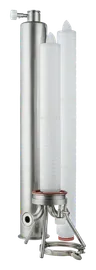
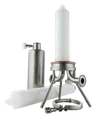
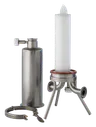
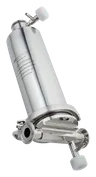
SaniFlow STE-01 and STE-X in AISI 304 with a ≤ 0.8 µm Ra finish; the STE-01 declares compliance with 3-A standards.
Stage by stage
Water prefiltration and reverse osmosis pretreatment with pleated polypropylene; high-flow and multi-cartridge housings.
Pleated polypropylene and glass microfiber to reduce turbidity and colloids; hybrid prefilters that protect the final membrane.
Final PES or nylon membranes for bottled water, soft drinks, beer, and unpasteurized alcoholic beverages.
A 0.65 µm PES membrane (LifePure W) and a graded 0.45 and 0.65 µm version for bioburden and yeasts. For pasteurized beer, a 5 µm ProFlow pleated polypropylene trap filter.
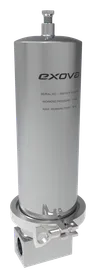
Filtration of syrups, colorings, and flavorings, with AISI 316L housings for one double-open-end (DOE) cartridge.
A 0.2 µm hydrophobic PTFE membrane for process air in contact with the product, packaging points, and venting of storage tanks and fermenters.
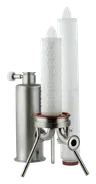
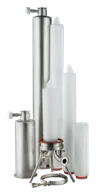
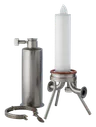
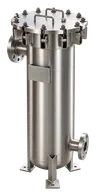
Single-cartridge or multi-element, in AISI 304 or 316L, with clamp, DIN 11851, and other connections depending on the code, and for one or three 7″ filter bags.
Frequently asked questions
It depends on the product and on what needs to be retained. As a reference, the final membrane catalogs state retention greater than 10⁷/cm² of Serratia marcescens at 0.45 µm and of Saccharomyces cerevisiae at 0.65 µm. We can help you define it with data from your line.
Yes. The beverage models withstand repeated sanitization cycles with hot water at 80 °C and with cleaning and disinfecting chemicals, as well as steam-in-place sterilization. The number of cycles depends on the process and on the integrity testing performed by the plant.
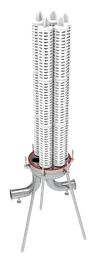
For low and medium flow rates, the SaniFlow STE-01 (single cartridge, AISI 304). For higher flow rates, the multi-element STE-X, from 3 to 36 cartridges. For high-flow process water, the SaniFlow HF with High Flow cartridges.
Technical blog
When to change a filter cartridge based on differential pressure: what ΔP measures, clean and change-out ΔP, warning signs, and how to log it batch by batch.

AISI 304 vs. 316L stainless steel in sanitary equipment: molybdenum, carbon and welding, chlorides, passivation, Ra finish, and when to use each one.

How a filter integrity test works on a cartridge: bubble point, diffusive flow, and pressure hold, how to wet the membrane, and when to run the test.
Talk to engineering
Tell us the fluid, the flow rate and the operating conditions. We reply with the model, the ordering code and the technical documentation.