
Filter cartridge integrity test: bubble point and diffusive flow
How a filter integrity test works on a cartridge: bubble point, diffusive flow, and pressure hold, how to wet the membrane, and when to run the test.
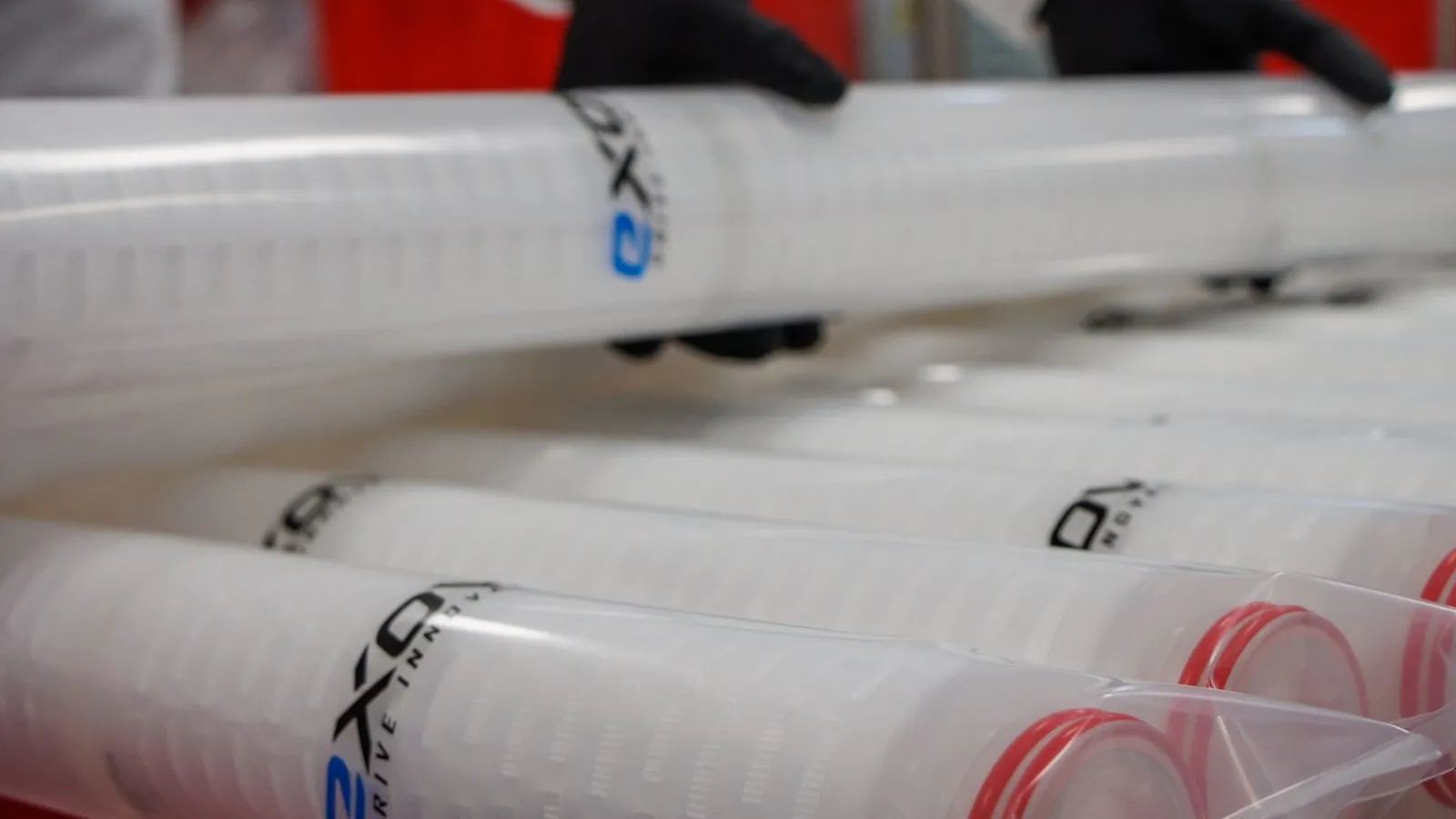
A filter integrity test is a non-destructive test that confirms a membrane cartridge is intact—with no out-of-specification pores, cracks, or seal leaks—and that it behaves like the cartridges that passed the validation bacterial challenge. For hydrophilic membranes such as PES and nylon 6,6, the most widely used methods are the bubble point and diffusive flow tests; pressure hold is an indirect way of measuring diffusion.
All three are performed with the membrane wetted, before and after filtration, and compare the result against a limit that the manufacturer must provide for each rating and cartridge length. In this article we explain how each method works, which errors invalidate it, and what the LifePure and UltraPure cartridges declare about integrity.
What a filter integrity test demonstrates
A membrane’s bacterial retention is validated with a microbiological challenge that destroys the filter being tested, as we explain in sterilizing filtration: what 0.2 µm means. To know whether the installed cartridge retains just as well, you need a physical measurement that does not damage it and is correlated with that challenge: that is the integrity test.
A properly performed test detects:
- pores larger than those of the validated rating;
- membrane damage, such as cracks or punctures;
- seal failures between the membrane and the cartridge ends;
- O-rings poorly seated in the housing, which let unfiltered fluid through.
It says nothing, however, about chemical compatibility, adsorption, or extractables, and it does not replace process validation. It is also only valid when compared against the reference values for that membrane, that filtration area, that wetting liquid, and that temperature.
How the bubble point test works
In a wetted membrane, the liquid is held in the pores by capillary action. Expelling it with gas takes a pressure that increases with the liquid’s surface tension and is inversely proportional to the pore diameter. If the gas pressure on the upstream side is raised gradually, the largest pores are the first to empty. At that point gas starts to flow continuously and steady bubbling appears on the downstream side: that pressure is the bubble point.
- Criterion: the measured bubble point must be equal to or greater than the minimum specified for that rating.
- Advantage: it gives direct information about the largest pore in the membrane.
- Limitation: with large areas—long cartridges or housings with several cartridges—a lot of gas diffuses before the bubble point is reached, and the transition becomes hard to read.
The liquid matters too. One with lower surface tension, such as an alcohol mixture, lowers the bubble point of the same membrane: values obtained with water do not apply if the cartridge is tested wetted with product.
How the diffusive flow test works
In the diffusive flow test (also known as forward flow or the diffusion test), a fixed test pressure below the bubble point, defined by the manufacturer, is applied. At that pressure the gas does not push the liquid out of the pores, but it dissolves into it on the upstream side, diffuses through the liquid film, and is released on the downstream side. The resulting flow, in mL/min, is proportional to the wetted area and the pressure differential.
- Criterion: the measured flow must be equal to or less than the specified maximum.
- What it detects: a defect or an out-of-rating pore adds bulk gas flow, and the value rises above the limit.
- Advantage: it evaluates the entire area at once, which is why it is the preferred method for large areas.
Because the value depends on the area, the limit changes with the cartridge length and with the number of cartridges in the housing.
Pressure hold
The pressure hold test (also called pressure decay) is a variant: the upstream side is pressurized to the test pressure and isolated, and the pressure drop over a fixed time is measured. The drop is due to diffusion plus any leak, and if the upstream volume is known, it is converted into diffusive flow. Many automated testers work this way, measuring on the upstream side without any intervention on the filtrate side. It is sensitive to temperature changes and to the volume of the installation.
| Method | What it measures | Acceptance criterion | Best suited for |
|---|---|---|---|
| Bubble point | Pressure at which the largest pores empty | Measured value ≥ specified minimum | Single cartridges and small areas |
| Diffusive flow | Flow of gas diffusing at a fixed pressure | Measured flow ≤ specified maximum | Large areas and housings with several cartridges |
| Pressure hold | Upstream pressure drop over a fixed time | Drop ≤ maximum calculated for that volume | Automated testers that measure on the upstream side |
How to wet the membrane so the test is valid
All methods start from the same condition: the membrane fully wetted, with all its pores filled with liquid. PES and nylon 6,6 membranes are hydrophilic and wet with water. If a dry area remains, gas passes through it and the cartridge fails even though it is sound: this is one of the most common causes of a false failure.
Good practices:
- Wet with the liquid, flow rate, and time specified by the manufacturer, and vent the housing so no air pockets remain.
- Drain the downstream side before measuring and let the temperature stabilize.
- Flush out the product thoroughly: residual alcohol or surfactants lower the surface tension and change the result.
- After a failed test, rewet and repeat the test before rejecting the cartridge.
The housing has to support this, with a vent at the high point and a drain at the low point. The SaniFlow STU-01 sanitary housing, made of AISI 316L stainless steel, comes with a vent and drain fitted with hose connect/disconnect valves, which make it easier to test the installed cartridge.
For hydrophobic membranes, such as those used for venting and gas filtration, other methods are used, for example water intrusion.
Before and after filtration: when to run the test
- Before use: detects damage from shipping, assembly, or steam sterilization, and confirms that the installed cartridge is the correct rating and that the O-rings are properly seated. In pharmaceuticals, EU GMP Annex 1 (2022 revision) requires the sterilizing-grade filter to be tested after sterilization and before use (PUPSIT), unless a risk assessment justifies a different approach.
- After use: confirms that the filter remained integral throughout filtration. The FDA guidance on aseptic processing states that it should be performed routinely and, in a pharmaceutical process, the result is part of batch release.
In wine and beverages, membrane cartridges are sanitized and reused, so the test is repeated after each sanitization or steam cycle and before each final filtration. We cover this in our article on microbial stabilization of beverages before filling, and the stage-by-stage process for wineries is on our filtration for the wine industry page.
If a test fails, rewet the membrane, check the O-rings and how they are seated, the temperature, and the reference values, and repeat it. If the failure is confirmed, the cartridge is replaced and whatever was filtered with it is evaluated.
What the cartridge manufacturer should provide
To write the procedure, you need the integrity limits for each model, rating, and length: minimum bubble point or maximum diffusive flow, along with the test pressure, gas, wetting liquid, and temperature. For sterilizing grades, these limits must be correlated with the validated bacterial retention. Traceability also matters: lot, model, and rating of each cartridge.
This is what the LifePure and UltraPure catalogs declare about integrity:
| Model | Factory testing per the catalog | For the user |
|---|---|---|
| LifePure Plus F&B | 100% of cartridges integrity tested | Diffusive flow and bubble point values to repeat the test |
| UltraPure F&B | 100% tested; integrity checked at source by diffusive flow | Diffusive flow and bubble point values to repeat the test |
| UltraPure Plus F&B | 100% tested; integrity checked at source by diffusive flow | Diffusive flow and bubble point values to repeat the test |
| LifePure Plus Pharma | 100% tested, by diffusive flow and bubble point | Quality certificate per cartridge and validation guide |
| LifePure Protec Pharma | 100% tested | Quality certificate per cartridge and validation guide |
| UltraPure Plus Pharma | 100% tested, by diffusive flow and bubble point | Quality certificate per cartridge and validation guide |
| UltraPure Protec Pharma | 100% tested, by diffusive flow and bubble point | Quality certificate per cartridge and validation guide |
Three other models state it differently: the LifePure F&B, integrity checked at source by diffusive flow; the LifePure W, integrity tested at the plant; and the LifePure W Graded, integrity tested at the plant on request. The catalogs do not print the numerical values: ask us for them for the model, rating, and length you will use.
How we help with filter integrity testing
If you are setting up your plant’s integrity test procedure or need the reference values for a LifePure or UltraPure cartridge, write to our engineering team with the model, rating, length, and wetting liquid, and we will review it with you.
Frequently asked questions
What equipment is needed for an integrity test?
It can be done with a regulated gas supply, a calibrated pressure gauge, and a gas flow meter. Regulated processes use automated testers that pressurize, stabilize, measure, and record the result, and that record is kept with the batch documentation.
Which gas is used for the test?
Filtered, dry compressed air or nitrogen. It is best to use the gas stated in the manufacturer's specification, because diffusive flow depends on how much of that gas dissolves in the wetting liquid.
What can damage a cartridge between one test and the next?
Pressure surges, reverse flow, steam cycles outside the specified conditions, or an incompatible fluid. The LifePure and UltraPure catalogs limit the differential pressure to 5.5 bar in the forward direction and 0.69 bar in reverse flow, both at 25 °C. They also restrict steam to single open-end cartridges (configurations B to E).


