
Bacterial retention test (BRT): how sterilizing filtration is validated with your product
How sterilizing filtration is validated with your product in a bacterial retention test: worst case, bacterial viability, controls, and filter integrity.
The bacterial retention test (BRT) challenges a filter membrane with a very high load of a bacterium of known size, typically Brevundimonas diminuta: at least 10⁷ colony-forming units (CFU) per cm² of filtration area. If the filtrate comes out sterile, the membrane is considered sterilizing-grade. It is a destructive test: the challenged filter is not used again.
A cartridge’s retention certificate comes from that test, run at the factory with water or saline solution: it describes the filter, not your process. Product-specific validation repeats the challenge with your product and under your actual conditions.
Process validation and filter validation: what each one covers
- Process validation: covers the entire manufacture of the product, including each compounding and filling step. It may include filtration, but it is generally limited to specifying the filter.
- Filter validation: studies that step in depth through several tests: bacterial retention, compatibility, adsorption, extractables, and leachables.
Filter validation can be performed under standard or product-specific conditions. ASTM F838-20 draws the line in its own scope: its method measures retention under standard conditions and is not intended for product-specific validation, which has to use the product, or a surrogate fluid, and the process parameters. The FDA’s 2004 guidance on aseptic processing states that filter validation data should apply to the filter user’s products and conditions of use, even when someone else runs the test.
| Aspect | Standard conditions | Product-specific |
|---|---|---|
| Who performs it | The filter manufacturer | The plant, with the manufacturer or a laboratory |
| Fluid | Water, saline solution, ethanol, or another reference solvent | The product or a justified surrogate |
| Conditions | Those of the reference method | Those of the process, at worst case |
| What it demonstrates | That the membrane is sterilizing-grade | That retention holds with that product and that process |
| Integrity limit | With the reference wetting liquid | With the product, if the filter is tested wetted with it |
How a bacterial retention test is run with your product
The basis is the ASTM F838 method, which we review in what 0.2 µm means and how a sterilizing-grade filter is validated. What changes is everything around the challenge:
- Define the worst case and, from it, the test conditions.
- Study the viability of the bacterium in the product.
- Measure the integrity of the filters to be challenged.
- Challenge the filters with the inoculated product, or the fluid that replaces it, at the defined pressure, flow rate, time, and temperature.
- Recover and count: all of the filtrate passes through an analysis membrane, which is incubated, and the colonies are counted.
- Close out: the integrity test is repeated and the controls are reviewed.
The acceptance criterion does not change: no colonies of the challenge organism in the filtrate, with the controls performing as expected.
What happens if the product affects the challenge bacterium
If the product kills or inhibits the bacterium, the filtrate comes out sterile even if the membrane let cells through. That is why a viability study is done first: B. diminuta is inoculated into the product, and the population is counted at the beginning and end of the maximum contact time, at the process temperature. If the population holds, the bacterium is inoculated directly into the product.
The FDA’s 2004 guidance prefers that route because it assesses the effect of the product on both the membrane and the bacterium at the same time, and it warns that, with bactericidal or oil-based products, direct inoculation can lead to erroneous conclusions. EU GMP Annex 1 follows the same line: the product whenever possible and, if it is not suitable, a justified surrogate.
Typical cases are products containing preservatives, antibiotics, alcohol, or solvents, or with an extreme pH. PDA Technical Report 26 addresses these fluids, and the usual approaches are:
- Adjust the method, for example by shortening the bacterium’s exposure to the product.
- Modify the formulation: remove the preservative or the antimicrobial component and use it as the vehicle.
- Use a surrogate solution with viscosity, surface tension, pH, and ionic strength similar to those of the product, but harmless to the bacterium.
- Separate exposure and challenge: first filter the actual product under worst-case conditions and then, through the same filter, the challenge in a modified fluid.
- Use a bioburden isolate that is resistant to the product, if it is justified as an equivalent or greater challenge.
Any difference from the actual product is justified in the protocol. With alcohol or solvents, the filter also has to be compatible: the nylon 6,6 UltraPure Plus Pharma is indicated in its catalog for hydroalcoholic mixtures and solutions containing solvents.
How the worst case is chosen
When a plant filters several products, a worst-case approach is usually adopted: grouping the products into families and testing the least favorable one. Annex 1 provides for grouping the validation by strengths or variants of a product, provided it is performed under worst-case conditions and the grouping is justified. PDA Technical Report 26 frames retention studies on the basis of a risk assessment. Some parameters to consider:
| Parameter | What is assessed | Usual worst case |
|---|---|---|
| Batch size | Volume filtered per batch | The largest batch |
| Prefiltration | Step upstream of the sterilizing-grade filter | No prefiltration |
| Filter loading | Liters per cm² of filtration area | The highest |
| Reuse | Batches with the same filter | The maximum number of batches |
| Differential pressure | Pressure drop across the filter | The maximum operating value |
| Flow rate per unit area | Flow rate divided by filtration area | The maximum |
| Filtration time | Product contact with the filter | The longest |
Temperature and product properties also count: viscosity, surface tension, pH, and osmolality. If the filter is reused, the FDA’s 2004 guidance states that the maximum number of batches should be validated; the usual practice is to discard it after each one.
These parameters are used to build a scoring system: each product receives a value per parameter—for example, from 1 to 3 according to risk—the values are added up, and the product with the highest score is the worst case for the family. For the prefiltration parameter, the stage-by-stage overview of filtration for pharmaceuticals and biotech shows the prefilters that protect the sterilizing-grade filter.
Positive and negative controls, and good microbiological practices
A count of zero is only valid if the test was capable of detecting bacterial passage. That is why controls are run in parallel:
- Positive control: a more open membrane, usually 0.45 µm, challenged with the same suspension. It has to let bacteria through: this confirms that the cells arrived small and dispersed. According to the FDA’s 2004 guidance, B. diminuta has a mean diameter of 0.3 µm.
- Negative control: the same flow path, assembled and sterilized the same way, with uninoculated product. There should be no growth.
- Challenge count: the suspension is titered to confirm the load the filter received and that the bacterium remained viable.
Good microbiological practices prevent the opposite error, downstream contamination that is read as a filter failure: the filtrate flow path is assembled as a closed system and sterilized, the connections are aseptic, and the challenge suspension does not touch the filtrate side. If the product leaves residues that inhibit growth, the analysis membrane is rinsed before it is incubated.
How the test correlates with filter integrity
The challenge cannot be repeated on the filter that goes on the line. What extends its result to each production filter is a non-destructive physical test—bubble point, diffusive flow or, for hydrophobic membranes, water intrusion—whose results, according to Annex 1, should be correlated with the retention established in the validation. Each method is covered in detail in filter integrity test: bubble point and diffusive flow.
Product-specific validation adds one more consideration: the wetting liquid. If the plant tests the membrane wetted with product, the limit the manufacturer set with water does not apply as is, because a product with lower surface tension lowers the bubble point. Annex 1 includes that liquid and its specification value among the validation parameters, and PDA Technical Report 26 covers product-wetted tests in detail, for example through the ratio between the bubble point measured with product and with the reference liquid.
On the line, the SaniFlow STU-01 sanitary housing comes with a vent and drain that make it easier to test the installed cartridge.
How we do it: membrane, lot, and challenge under the same control
We developed our own method based on ASTM F838-20, aligned with the product-specific approach of Annex 1 and PDA Technical Report 26. It is run with your product and under your actual process conditions, on cartridges and capsules supplied by FluidsControl:
- Challenge suspension: a pressurized 20 L vessel with Brevundimonas diminuta ATCC 19146, for a challenge of 1 × 10⁷ CFU/cm².
- Sterilizing-grade filter: a 0.2 µm membrane cartridge in a 10″ housing.
- Analysis membrane: the filtrate is collected in a 47 mm membrane holder for counting. A retentive filter gives zero CFU.
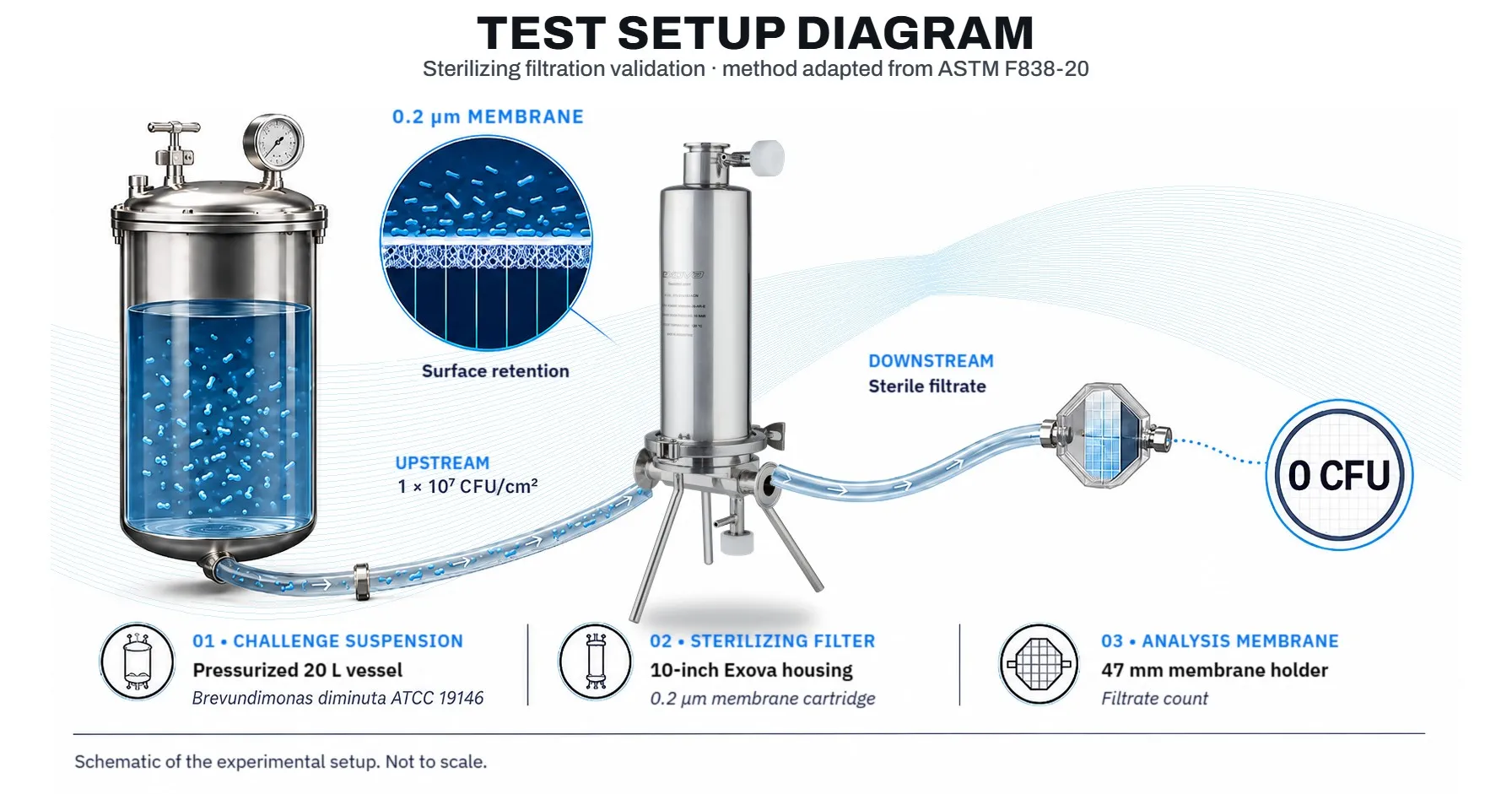
The challenge is performed on the complete filter; the FDA’s 2004 guidance notes advantages in using production filters in these studies. Because we manufacture the cartridge and run the test, the membrane, the lot, and the challenge are under the same control: pharmaceutical-grade cartridges are engraved with the lot, model, pore size, and part number.
Depending on the product, the filter can be PES, like the LifePure Plus Pharma; nylon 6,6, like the UltraPure Plus Pharma; or dual-layer for heavily loaded fluids, like the LifePure Protec Pharma and the UltraPure Protec Pharma. All four declare B. diminuta retention per ASTM F838-20 and have a validation guide: the starting point for the study with your product.
Tell us what product you filter
We don’t tell you how to run the test: we run it for you. If you are putting together the validation of a sterilizing filtration process, write to our engineering team with the product, the volume per batch, the filter you use, and the process conditions—pressure, flow rate, time, and temperature—and we will look at your specific case.
Frequently asked questions
How often does the bacterial retention test need to be repeated?
There is no fixed frequency: it is reviewed when something the study covered changes. For example, the formulation; the conditions that defined the worst case, such as pressure, time, or volume; or the type of filter or membrane. Each change goes through the plant's change control, which determines whether a documented justification is enough or a new test is needed.
What happens if colonies appear in the filtrate?
First, they are identified. If they are not the challenge organism, it is contamination of the test and is investigated as such, starting with the negative controls and handling. If they are the challenge organism, the controls and the integrity of the tested filter are reviewed; if everything is in order, that combination of filter, product, and conditions is not validated and has to be redesigned (a different membrane or rating, less severe conditions, or an additional filtration step) before the test is repeated.
Does the bacterial retention test replace the sterility test?
No: they are different controls that complement each other. The retention test demonstrates, once and under worst-case conditions, that the filtration retains bacteria with that product; the integrity test confirms at each use that the installed filter matches the validated one; and the sterility test analyzes a sample of the finished product. None of them replaces the other two.


