
Sterilizing filtration: what 0.2 µm means and how a filter is validated
Sterilizing filtration: what defines a sterilizing-grade filter, how ASTM F838 bacterial retention is validated, and when to use 0.1 µm instead of 0.2 µm in pharma.
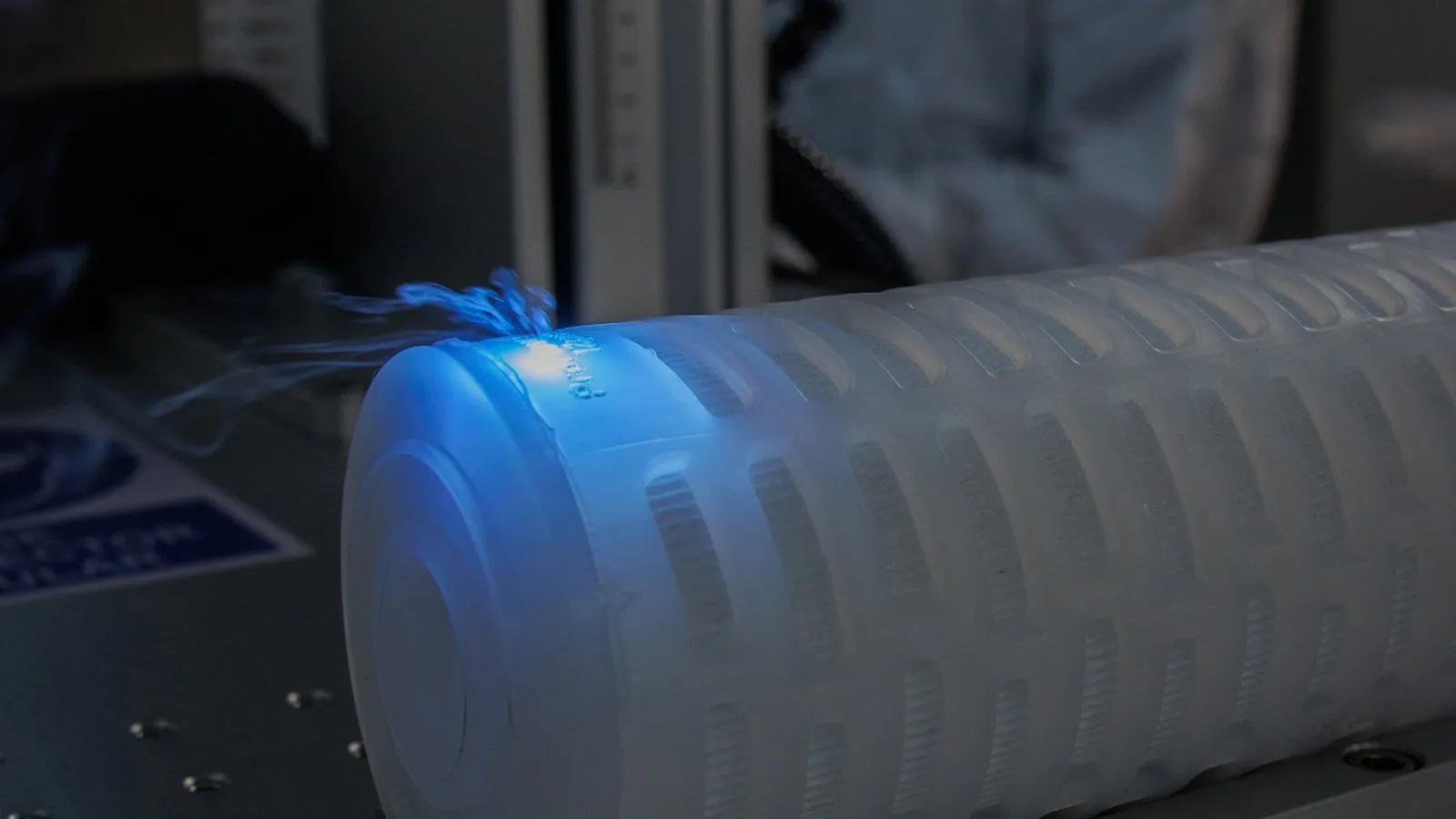
A sterilizing-grade filter is one that delivers a sterile filtrate when challenged with at least 10⁷ Brevundimonas diminuta bacteria per cm² of filtration area. That is the basis of sterilizing filtration: the challenge method is standardized in ASTM F838, and the “0.2 µm” on the label is the name of the rating that passes that test, not a pore measurement taken with a ruler.
Validating a filter has two parts. The manufacturer demonstrates the membrane’s bacterial retention and links it to an integrity test that does not destroy the cartridge. The plant that uses the filter demonstrates that this retention holds with its own product and process conditions, and tests the integrity of each filter before and after use. In this article we go through each step, when it is necessary to go down to 0.1 µm, and what the LifePure and UltraPure pharmaceutical-grade cartridges declare.
What a sterilizing-grade filter is and what “0.2 µm” means
A microfiltration membrane is not a sieve with identical holes. It is a network of pores with a distribution of sizes and a tortuous path through its thickness. That is why the rating is not defined by measuring a pore, but by what the membrane retains in a standardized test.
The FDA guidance on sterile drug products produced by aseptic processing (2004) defines a sterilizing filter by its result: it must reproducibly remove viable microorganisms from the fluid and produce a sterile effluent. The same guidance notes that these filters usually have a rated pore size of 0.2 µm or smaller.
The 0.2 µm and 0.22 µm designations are used interchangeably: each manufacturer labels its sterilizing grade with one or the other. What makes two filters equivalent is not the printed figure but the result of the bacterial challenge.
How bacterial retention is validated under ASTM F838
ASTM F838 describes how to determine the bacterial retention of membrane filters used for liquid filtration (our catalogs cite the F838-20 revision). The challenge organism is Brevundimonas diminuta (ATCC 19146), a very small bacterium that represents the worst case for a 0.2 µm membrane. In general terms, the test follows these steps:
- A suspension of the organism is prepared at a known concentration.
- It is passed through the membrane until at least 10⁷ colony-forming units (CFU) per cm² of effective filtration area have been applied.
- All of the filtrate is collected on an analysis membrane, which is incubated on a culture medium.
- If no colonies grow, the filtrate is sterile and the membrane retained the full challenge.
That is exactly what the catalogs for the LifePure Plus Pharma, the LifePure Protec Pharma, the UltraPure Plus Pharma, and the UltraPure Protec Pharma declare: they were evaluated under ASTM F838-20 with B. diminuta (ATCC 19146) at a challenge of ≥ 10⁷ CFU/cm², with complete retention, and they meet the requirements for 0.2/0.22 µm sterilizing-grade filters.
Process validation falls to the user’s plant
The manufacturer’s test is run with a reference fluid, and the actual product can change the result. Among the factors that affect filter performance, the FDA lists the fluid’s viscosity and surface tension, pH, the compatibility of the formulation with the membrane, pressure, flow rate, temperature, and maximum use time.
That is why each process validates bacterial retention with its own product under worst-case conditions, usually in a laboratory using discs of the same membrane. All four models mentioned have a validation guide available to help put that validation package together.
0.2 or 0.1 µm? When mycoplasma retention is needed
For sterilizing filtration, 0.2 µm is the reference rating. The reason to go down to 0.1 µm is mycoplasmas: very small, deformable bacteria with no cell wall that can pass through a 0.2 µm membrane. The risk arises mainly in cell culture media, sera, and components of animal origin.
ASTM F838 does not cover this case. To qualify mycoplasma retention, the challenge organism used is Acholeplasma laidlawii, which belongs to the same class as mycoplasmas (Mollicutes). These are the models whose catalogs declare that retention for the 0.1 µm rating:
| Model | Membrane | A. laidlawii at 0.1 µm | B. diminuta at 0.1 and 0.2 µm |
|---|---|---|---|
| LifePure | PES | > 10⁴/cm² | > 10⁷/cm² |
| LifePure Plus | PES | > 10⁴/cm² | > 10⁷/cm² |
| LifePure Protec (0.1 + 0.4 µm) | PES, dual layer | 10⁴/cm² | 10⁷/cm² |
| UltraPure F&B | Nylon 6,6 | > 10⁴/cm² | > 10⁷/cm² |
| UltraPure | Nylon 6,6 | > 10⁴/cm² | > 10⁷/cm² |
| UltraPure Plus F&B | Nylon 6,6 | > 10⁴/cm² | > 10⁷/cm² |
| UltraPure Plus | Nylon 6,6 | > 10⁴/cm² | > 10⁷/cm² |
The four pharmaceutical-grade models (LifePure Plus Pharma, LifePure Protec Pharma, UltraPure Plus Pharma, and UltraPure Protec Pharma) offer 0.1 µm, either as a rating or as the final layer, and declare B. diminuta retention, but their catalogs do not report A. laidlawii retention. If your validation needs mycoplasma retention data, check with us which model and which documentation apply.
Moving to 0.1 µm comes at a cost: for the same filtration area, a tighter membrane gives less flow or requires more pressure. That is why 0.1 µm is reserved for processes where the mycoplasma risk justifies it.
USP <88> Class VI and USP <665>: what the pharmaceutical-grade models add
In the LifePure and UltraPure lines, the pharmaceutical-grade models are the Pharma versions. All four share a quality package designed for regulated processes:
- ASTM F838-20: complete bacterial retention with B. diminuta, as described above.
- USP <88>: in vivo biological reactivity tests. All four meet the acceptance criteria for Class VI plastics, the most stringent of the six USP classes.
- USP <665>: the chapter on plastic components used in the manufacture of drug products and their extractables. The catalogs report that no significant levels of compounds that could interfere with the process or with product safety were found; for the UltraPure Plus Pharma and UltraPure Protec Pharma, the study was performed with representative solvents.
- Traceability: integrity tested on 100% of cartridges at our plant; engraving of lot, model, pore size, and part number; a quality certificate per unit; and a validation guide.
- Manufacturing: ISO 7 clean area, a purified water rinse after manufacturing to remove extractables, and materials compliant with FDA 21 CFR 177 for food contact.
These are the documents a validation package requires for a product-contact filter: biological safety of the materials, extractables assessment, and traceability of each unit. Our page on filtration for pharmaceuticals and biotech organizes these models by process step, along with prefilters and housings.
Single or dual layer: how to choose a cartridge for sterilizing filtration
| Model | Membrane | Construction | Ratings | Filtration area per 10″ |
|---|---|---|---|---|
| LifePure Plus Pharma | Asymmetric PES | Single layer | 0.1 to 1.2 µm | 8,000 cm² |
| LifePure Protec Pharma | Asymmetric PES | Dual layer | 0.1 + 0.2 to 0.8 + 1.2 µm | 6,500 cm² |
| UltraPure Plus Pharma | Nylon 6,6 | Single layer | 0.1 to 1.2 µm | 9,500 cm² |
| UltraPure Protec Pharma | Nylon 6,6 | Dual layer | 0.1 + 0.2 to 0.65 + 0.8 µm | 7,500 cm² |
In the Protec models, the upstream layer is more open and works as a prefilter: it retains the larger contaminants and protects the final layer, which defines the rating. According to their catalogs, this increases dirt-holding capacity and extends service life in fluids with a high particle load or bioburden. It is not a redundant barrier: each layer has a different pore size.
For sterilizing filtration, the LifePure Protec Pharma specifies the 0.1 + 0.2 µm combination for critical biological and pharmaceutical solutions, and the 0.2 + 0.4 µm combination, which adds high-efficiency prefiltration, for heavily loaded fluids. In the UltraPure Protec Pharma, the sterilizing-grade combinations are those with a 0.1 or 0.2 µm final layer: 0.1 + 0.2 µm and 0.2 + 0.45 µm.
A single layer, on the other hand, fits more filtration area into the same cartridge: 8,000 vs. 6,500 cm² in LifePure and 9,500 vs. 7,500 cm² in UltraPure. With clean fluids, more area means more flow at the same pressure drop. The choice between PES and nylon 6,6 depends mainly on the fluid chemistry, and we cover it in PES or nylon membrane: how to choose the final filter.
From the bacterial challenge to the integrity test
The B. diminuta challenge is destructive: it cannot be performed on the cartridge that will be installed. The bridge between validation and each individual unit is the integrity test, a non-destructive physical measurement—bubble point or diffusive flow—whose limits the manufacturer correlates with bacterial retention. A cartridge that meets those limits behaves like the ones that passed the challenge. The FDA guidance calls for the integrity specification of the production filter to be consistent with the data from the retention validation.
At the user’s plant, the test is repeated with every use:
- Before filtration, to detect damage from shipping, installation, or sterilization. The 2022 revision of EU GMP Annex 1 requires this test to be performed on the filter after sterilization (PUPSIT), unless a risk assessment justifies a different approach.
- After filtration, to confirm that the filter remained integral throughout the batch. The FDA states that post-use testing should be performed routinely.
All four pharmaceutical-grade models are integrity tested at our plant, one by one. How each method works and which errors invalidate it are covered in our article on the filter integrity test by bubble point and diffusive flow.
How we help you choose and validate your sterilizing-grade filter
We manufacture LifePure and UltraPure cartridges in an ISO 7 cleanroom. If you are defining the rating, membrane, or construction of a sterilizing-grade filter, or you need the validation guide and certificates for a model, contact our engineering team with your fluid, volume per batch, and process conditions.
Frequently asked questions
Should two sterilizing-grade filters be used in series?
It is common practice when the process risk justifies it: if the primary filter fails its post-use integrity test, the second one provides backup. The FDA guidance on aseptic processing states that the use of redundant sterilizing filters should be considered in many cases. Each filter in the series is integrity tested separately.
When should a sterilizing-grade cartridge be replaced?
When it fails the integrity test, when the maximum validated use time is reached, or when the differential pressure reaches the change-out value. The catalogs for the LifePure Plus Pharma, the UltraPure Plus Pharma, and the UltraPure Protec Pharma set the maximum differential pressure for change-out at 2 bar; the LifePure Protec Pharma catalog gives 2 bar as the recommended value.
What happens if the integrity test fails after filtration?
First, rule out causes related to the test itself: incomplete wetting, poorly seated O-rings, unstable temperature, or reference values that do not correspond to that cartridge. If the failure is confirmed on retest, the filtered batch cannot be considered sterile and is investigated under the plant's quality system.


