
AISI 304 vs. 316L stainless steel in sanitary equipment: differences and when to use each
AISI 304 vs. 316L stainless steel in sanitary equipment: molybdenum, carbon and welding, chlorides, passivation, Ra finish, and when to use each one.
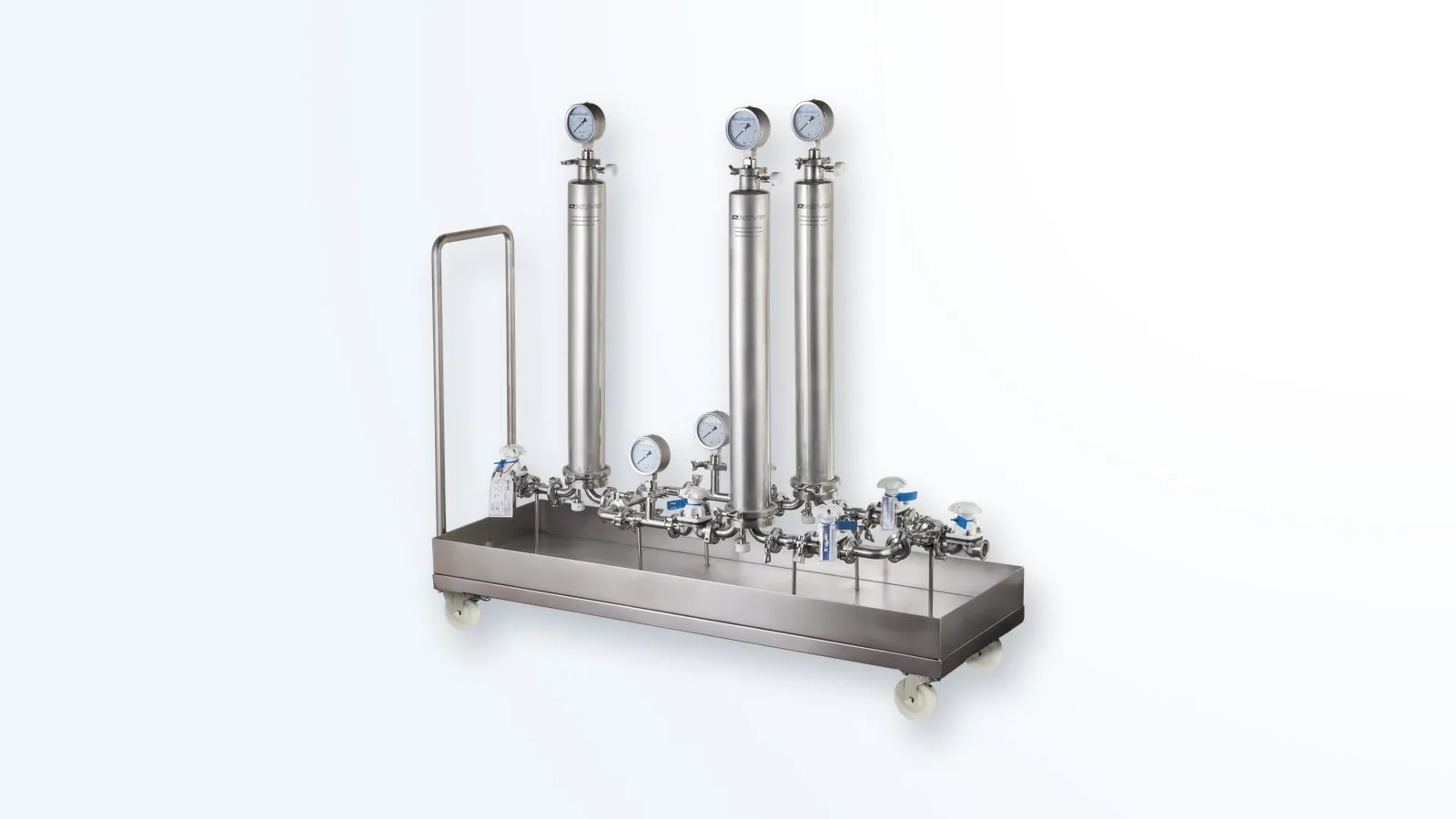
The difference between AISI 304 and 316L stainless steel comes down to two elements. 316L contains 2 to 3% molybdenum, which improves pitting resistance in chloride-bearing media, and it limits carbon to 0.03%, which protects welded zones from intergranular corrosion. 304 contains no molybdenum and, in its standard grade, allows up to 0.08% carbon.
In sanitary equipment, the rule of thumb is this: 316L for product-contact surfaces in pharmaceutical and biotech processes, with fluids that contain chlorides, or with aggressive cleaning; 304 for mild food and beverage applications and for structures that do not touch the product. Below is the reasoning behind each case and how we apply it in Exova equipment.
How 304 and 316L stainless steel differ chemically
Both are austenitic stainless steels: they share an iron, chromium, and nickel base, which is why they look the same, are fabricated in similar ways, and appear in the same equipment. What separates them is their composition and what that composition changes in service.
| Property | AISI 304 | AISI 316L |
|---|---|---|
| Chromium | ≈ 18% | 16 to 18% |
| Nickel | ≈ 8% | 10 to 14% |
| Molybdenum | None | 2 to 3% |
| Maximum carbon | 0.08% | 0.03% |
| Resistance to chloride pitting | Moderate | Higher, due to molybdenum |
| Sensitization during welding | Possible | Low |
| Cost | Lower | Higher |
| Typical use in sanitary equipment | Mild food and beverage; structures | Pharma and biotech; chlorides; frequent CIP and SIP |
The exact ranges depend on the standard for each product form (sheet, tube, or bar). The “18/8” name by which 304 is known comes from its 18% chromium and 8% nickel. There is also 304L, with the same 0.03% carbon cap as 316L, but without molybdenum.
What the “L” means and why it matters in welding
The L stands for low carbon, and welding is the reason it exists. When the zone next to the weld bead spends time at intermediate temperatures, carbon combines with chromium and forms carbides at the grain boundaries. Around those carbides, the steel is left with less chromium than it needs to sustain its passive layer and becomes vulnerable to intergranular corrosion. This phenomenon is called sensitization.
With carbon limited to 0.03%, far fewer carbides form, and the welded zone keeps its corrosion resistance without post-weld heat treatment. In sanitary equipment, where the welds are on the product side and are exposed to cleaning agents, this is a practical difference.
That is why material and welding are specified together. The SaniFlow STU-X declares polished orbital welds, and the SNU-K is built with orbital welding and CNC machining and is supplied with a welder qualification certificate.
Chlorides and pitting: where 316L makes the difference
Both steels resist corrosion thanks to a passive chromium oxide layer, a few nanometers thick, that forms spontaneously in contact with oxygen. Chloride ions break it down at isolated points and open pits: small cavities that progress inward while the rest of the surface looks intact. The same happens in crevices, under gaskets, and in areas where liquid stagnates.
Molybdenum stabilizes the passive layer against chlorides. The PREN index, used to compare pitting resistance (PREN = %Cr + 3.3 × %Mo + 16 × %N), comes out several points higher for 316L than for 304.
Chlorides get in through more routes than you might think:
- brines, sauces, and salty products;
- physiological solutions, buffers, and culture media;
- city water used for rinsing;
- chlorinated sanitizers, such as sodium hypochlorite.
Two caveats. 316L resists more, not everything: with high chlorides, low pH, high temperature, or stagnant liquid, it pits too. And neither 304 nor 316L is immune to chloride stress corrosion cracking at elevated temperatures; for those conditions, other alloys are evaluated.
Passivation: how the protective layer is restored
The passive layer regenerates on its own, but fabrication compromises it. Carbon steel tools, cutting discs, and brushes leave free iron particles on the surface, and welding heat forms colored oxides. Pickling removes those oxides, and chemical passivation—with nitric or citric acid, per ASTM A380 and ASTM A967—removes the free iron so the passive layer forms evenly.
It is a step worth requesting in writing. The STU-X declares chemical passivation of 100% of the units and is supplied with a passivation certificate; the SaniFlow HF declares a pickled and passivated interior. After a weld repair or mechanical damage, the affected area is passivated again.
Surface finish and Ra: the other half of cleanability
The material decides how much the steel resists; the finish decides how hard it is to clean. Roughness is expressed as Ra: the arithmetic mean of the deviations of the surface profile from its mean line, in micrometers. With a low Ra there are fewer valleys where residues and microorganisms lodge, the surface drains better, and it responds better to clean-in-place (CIP). There are also fewer points where a pit can start.
Ra is specified separately for the product-contact surfaces and for the exterior. In the AISI 316L SaniFlow housings for pharma—STU-01, STU-X, SNU-01, SNU-K, and STU-50—the interior is polished to Ra 0.4 µm or less; in the AISI 304 housings for food and beverage, the STE-01 and STE-X, to Ra ≤ 0.8 µm. Material and finish go together: a 316L with a poor finish loses much of its sanitary advantage.
When to use 304 vs. 316L
Pharmaceutical and biotech
316L for everything that touches the product: purified water and water for injection, buffers and media with chlorides, repeated steam cycles, and cleaning with caustic and acids. It is the usual material in equipment designed to ASME BPE, such as the SaniFlow STU-X housing. 304 is left for structures, supports, and trays that do not touch the product.
Food and beverage
304 is enough for many mild applications: waters, juices, dairy, and beverages. The SaniFlow STE-01 catalog presents it that way, as a steel that balances cost and corrosion resistance. Moving to 316L makes sense with salty or chloride-rich products, with frequent chlorinated sanitization, or with sustained high temperatures. The filtration stages for each beverage are covered in filtration for food and beverage.
Wine industry
Both coexist in the winery. The SaniFlow STE-X multi-element housing, in AISI 304, is listed in its catalog for wine prefiltration and final filtration, and the STE-DO, in AISI 316L, for syrups, wines, and liqueurs. The choice depends on the product and on each winery’s cleaning and sanitization routine.
How we use 304 and 316L in Exova equipment
In SaniFlow housings, the material is defined by model:
- STU-01, STU-X, STU-50, SNU-01, and SNU-K: AISI 316L, for pharmaceutical and biotech processes.
- STE-01 and STE-X: AISI 304, for food and beverage; the STE-X, also for wine and drinking water.
- STE-DO: AISI 316L in all product-contact parts, for process filtration with one DOE cartridge.
- SaniFlow HF: AISI 304 or 316L, selected in the code.
316L does not have to be used throughout the unit. In the STU-X, the product-contact parts are 316L, and the frame and legs are 304 or 316L as specified. In the custom skids we design, the steel is chosen for the process: in the STE-DO skids, product contact is 316L and the frame is 304. For the rest of a housing specification, see how to choose a sanitary filter housing.
The same reasoning applies to the AgileReact containers, made of AISI 304, which hold 3D single-use bags from 50 to 2,000 L. There the product does not touch the steel: the bag contains it. What the container needs is mechanical strength, easy cleaning, and tolerance to the chemical agents used in GMP production.
We help you define the material
If you are unsure whether to use 304 or 316L for a housing, a skid, or a container, send us the fluid, its chloride content, the temperature, and the cleaning and sanitization program. With that, we will recommend the material for each part and the right finish. Contact the Exova engineering team.
Frequently asked questions
Can 304 and 316L be told apart by eye?
No. They look the same and, since both are austenitic, a magnet cannot tell them apart either. You have to check the material's mill certificate (the SaniFlow STU-X is supplied with the EN 10204 3.1 certificate for its product-contact parts) or run a composition analysis that detects molybdenum, for example with a handheld X-ray fluorescence analyzer.
Can 304 and 316L parts be combined in the same installation?
Yes. The two steels sit very close together in the galvanic series, and contact between them does not cause appreciable galvanic corrosion. What you need to keep in mind is that the assembly only resists as much as its weakest part: if the fluid calls for 316L, every part in contact with the product has to be made of it, including fittings, valves, and welds.
What is dual-certified 316/316L material?
It is steel that meets two specifications at once: the 0.03% maximum carbon of 316L and the minimum mechanical properties of 316, which are somewhat higher. It is common in sheet, tube, and bar. In a welded sanitary unit it behaves as 316L.


