
How to choose a sanitary filter housing: material, finish, connections, and pressure
How to choose a sanitary filter housing: service, cartridges, 304 or 316L steel, Ra finish, connections, pressure, sterilization, and documentation.
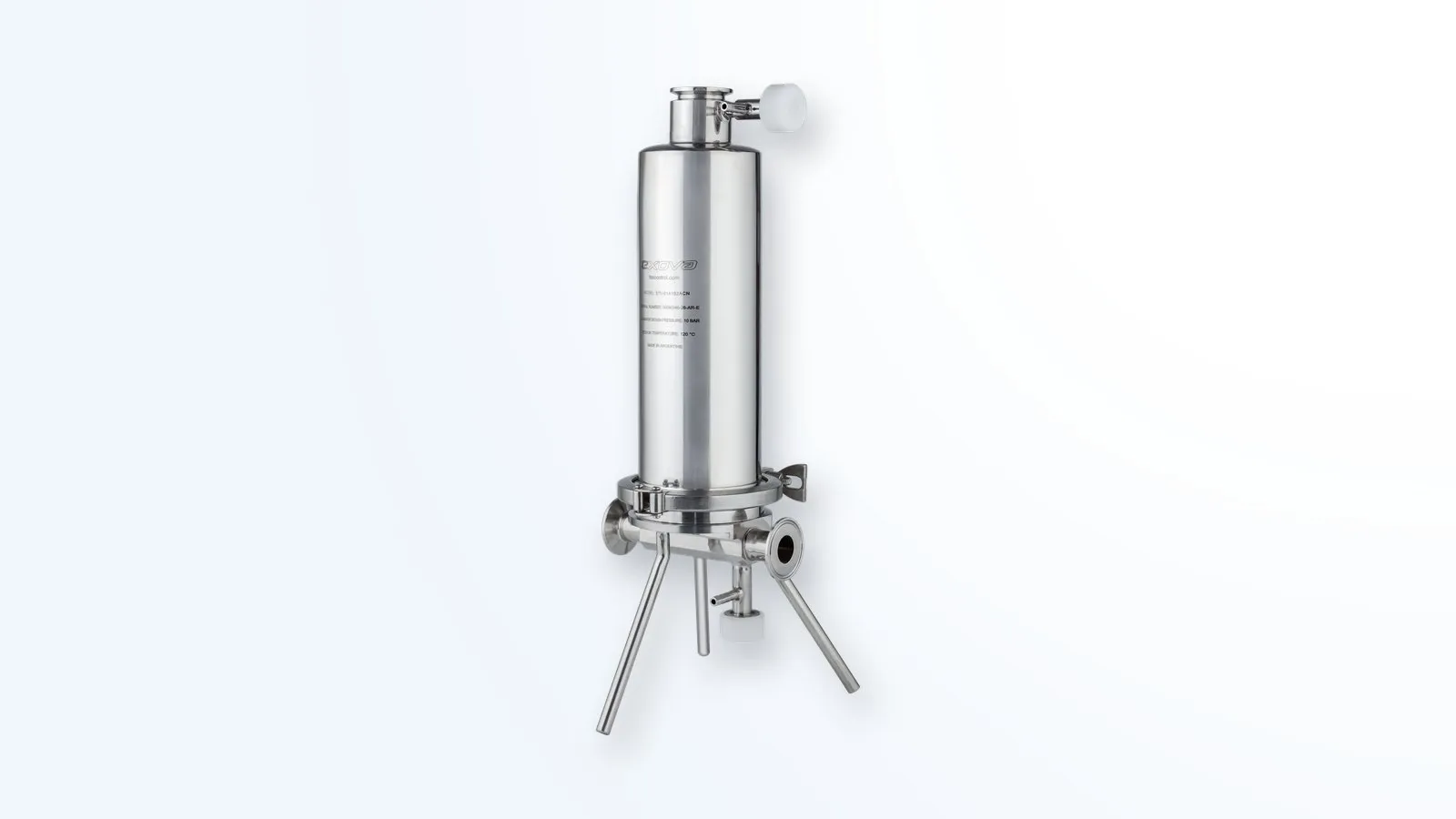
To choose a sanitary filter housing, define the following, in this order: what fluid passes through it (liquid, air, or vent gas), how many cartridges are needed and with which adapter, the steel for the product-contact parts (AISI 304 or 316L), the interior finish expressed as Ra, the process connections, the working pressure and temperature, the sterilization method, and the documentation the process requires. Each decision rules out models, and usually only one is left at the end.
Below is each criterion with the catalog data for the nine SaniFlow housings, summarized in the table at the end.
What fluid passes through the housing: liquid, air, or vent gas
The first cut is the service. For liquids there are the single-cartridge STU-01 and STE-01; the multi-element STU-X and STE-X; the STE-DO, for DOE cartridges; and the SaniFlow HF, for High Flow cartridges.
For air and gases, the reference is the SaniFlow SNU-01, in AISI 316L: sterile air filtration in pharmaceutical processes, ventilation of sterile environments, and venting of tanks and reactors. For small flow rates there are the SNU-K and STU-50 mini housings, which filter gases as well as low- and medium-volume liquids.
Venting tanks that hold hot fluids
A vent filter uses a hydrophobic membrane: it lets air through and stops liquid. If the tank holds a hot fluid, vapor condenses in the housing, the condensate wets the membrane and blocks the airflow, and the tank can be pulled into vacuum as it cools or empties. For that case, the SNU-01 is ordered with electric heating or with a steam heating jacket (E or V in the last field of the code), as is the SNU-K.
How many cartridges: single-element, multi-element, or High Flow
The number of cartridges follows from the flow rate and the filtration area the process needs. For one 10″ to 40″ cartridge there are the STU-01 and STE-01. If more are needed, the STU-X and STE-X hold 3, 6, 9, 12, 16, 22, 24, or 36 cartridges from 10″ to 40″, and more on request.
At the other end of the range, the STU-50 holds a mini cartridge with an internal 116 O-ring and the SNU-K holds an SKN cartridge, both in 5″ or 2.5″.
For high-flow process water, the SaniFlow HF works with 6″ (152 mm) High Flow cartridges: the vertical HFV-01 takes one, and the horizontal HFH-03, HFH-04, and HFH-05 take 3, 4, and 5. They cover recommended flow rates of 17 to 250 m³/h per housing, depending on the model and the cartridge length (20″, 40″, or 60″), and they are designed and manufactured at our stainless steel fabrication plant in Argentina.
Which cartridge goes inside: 222, 226, or DOE adapter
The housing has to match the cartridge end. The STU-01, STE-01, SNU-01, STU-X, and STE-X accept four double O-ring configurations:
- B: 2 × 226 O-rings + fin
- C: 2 × 222 O-rings + fin
- D: 2 × 226 O-rings + flat end
- E: 2 × 222 O-rings + flat end
222 and 226 are the sizes of the open-end O-rings; fin and flat end are the two shapes of the closed end. The O-rings seal against the housing receptacle and separate the dirty side from the clean side with a positive seal, which is what sterilizing filtration requires. Exova membrane and prefilter cartridges use the same letters in their codes, so housings and cartridges can be matched directly.
The double open end cartridge (DOE, configuration F) is held between flat gaskets and does not provide that positive seal, which is why the STU-X does not accept it. Where that seal is not needed—syrups, wines, liqueurs, process water, and pharmaceutical and cosmetic process fluids—there is the SaniFlow STE-DO, an industrial AISI 316L filter housing for one 10″ to 40″ DOE cartridge. Cartridge change-out is tool-free: the bowl is released with a single clamp, and a central tie rod holds the cartridge. For several DOE cartridges, the STE-X accepts configuration F.
Material and interior finish of a sanitary filter housing
The steel of the product-contact parts separates two families. The STU-01, STU-X, SNU-01, SNU-K, and STU-50 are made of AISI 316L, for pharma and biotech. The STE-01 and STE-X are made of AISI 304, for food and beverage. The STE-DO uses 316L in all product-contact parts, and the SaniFlow HF can be ordered in 304 or 316L.
The difference lies in the molybdenum in 316L, which improves resistance to chloride pitting, and in its low carbon content, which protects the welds. We go into this in differences between AISI 304 and 316L stainless steel.
The interior finish is specified by average roughness (Ra, in µm): the lower it is, the fewer valleys where residues remain and bioburden takes hold, and the simpler it is to validate cleaning. Those five 316L housings have the interior finished to Ra 0.4 µm or less, the STU-X with sanitary mechanical polishing. The STE-01, STE-X, and HF are finished to Ra ≤ 0.8 µm, and the HF is also pickled and passivated inside. The STE-DO declares a bright polish inside and out, with no Ra value.
Geometry matters as much as Ra: the STU-01 drains from its lowest point and reduces dead volume, and the STU-X has a bowl bottom sloped toward the drain, generous internal radii, and polished orbital welds.
Process connections, pressure, and temperature
The connections have to match the line and follow sanitary design criteria. The STU-X is offered with clamp only, from 1 1/2″ to 4″, because threaded and flanged joints leave crevices that do not drain. The STE-X has the most options, thirteen: clamp from 1 1/2″ to 3″, DIN 11851 (NW40, NW80, and DN50 with nut), 2″ Danish, 4″ flange, and 44.5 and 68 mm Fafeur. On the HF, the SORF ANSI #150 flanges range from 3″ to 10″ and are chosen by model and cartridge length to keep the velocity in the connections low. The rest are listed in the table.
On pressure and temperature, three details: the STE-01, STU-50, and SNU-K also work under vacuum, from −1 bar; on the STU-X and STE-X, the −10 to 150 °C range depends on the gasket elastomer; and the STE-DO is designed for 7 bar and 90 °C. The chosen range has to cover the sterilization cycle, not just normal operation.
Sterilization and documentation for regulated processes
If the housing is going to be steam sterilized, the catalog has to say so. The STU-01 can be sterilized in place (SIP) and in an autoclave; the STU-X withstands repeated SIP cycles with clean steam at 121–135 °C; and the SNU-01, STU-50, and STE-X allow clean-in-place and steam-in-place (CIP and SIP). The catalogs for the STE-01, STE-DO, SNU-K, and HF do not state a sterilization cycle: if your process needs one, confirm it before requesting a quote.
Documentation is the other filter. The SaniFlow STU-X multi-element housing declares the most: design following ASME BPE guidelines, chemical passivation and hydrostatic testing of 100% of the units, an EN 10204 3.1 mill certificate for the product-contact parts, a passivation certificate, elastomers with an FDA 21 CFR 177 and USP Class VI declaration of conformity, and optional IQ/OQ protocols.
The SNU-01 meets the requirements of the Pressure Equipment Directive (PED 2014/68/EU) and is supplied with a quality certificate. The STE-01 complies with 3-A sanitary standards.
The STU-01, STU-50, and SNU-K come with vent and drain valves or connections designed for cartridge integrity testing. For how it is done, see filter integrity testing by bubble point and diffusive flow.
Which SaniFlow housing fits each case
| Model | AISI steel | Cartridges | Interior | Max. P · T | Connections | Use |
|---|---|---|---|---|---|---|
| STU-01 | 316L | 1 · 10″ to 40″ | Ra 0.4 µm | 10 bar · 140 °C | Clamp 1 1/2″ | Liquids, pharma |
| STU-X | 316L | 3 to 36 · 10″ to 40″ | Ra ≤ 0.4 µm | 10 bar · −10 to 150 °C | Clamp 1 1/2″ to 4″ | Regulated pharma, high flow |
| SNU-01 | 316L | 1 · 10″ to 40″ | Ra ≤ 0.4 µm | 10 barg · 150 °C | Clamp 1 1/2″ | Air, gases, and venting |
| STU-50 | 316L | 1 mini · 2.5″ or 5″ | Ra < 0.4 µm | −1 to 10 barg · 150 °C | Clamp 3/4″ or 1 1/2″, BSP 1/2″ | Liquids and gases, low volume |
| SNU-K | 316L | 1 mini SKN · 2.5″ or 5″ | Ra ≤ 0.4 µm | −1 to 10 barg · 150 °C | Clamp 1 1/2″ | Air, gases, and liquids |
| STE-01 | 304 | 1 · 10″ to 40″ | Ra ≤ 0.8 µm | −1 to 10 bar · −10 to 150 °C | Clamp 1 1/2″ or Fafeur 44.5 mm | Juices, waters, dairy |
| STE-X | 304 | 3 to 36 · 10″ to 40″ | Ra ≤ 0.8 µm | 10 bar · −10 to 150 °C | Thirteen options | Beverages, wine, drinking water |
| STE-DO | 316L | 1 DOE · 10″ to 40″ | Bright polish | 7 bar · 90 °C | Clamp 1 1/2″ or 1″ or 2″ female BSP | Process filtration |
| HF | 304 or 316L | 1, 3, 4, or 5 High Flow 6″ · 20″ to 60″ | Ra ≤ 0.8 µm | 10 bar at 80 °C (design) | ANSI #150 flanges, 3″ to 10″ | Process water |
As a guide: for pharmaceutical and biotech, STU-01 or STU-X depending on the flow rate, and SNU-01 for air and venting; for food and beverage, STE-01 or STE-X, which also covers wine; with DOE cartridges, STE-DO; and for high-flow process water, HF.
How we help you choose the housing
Based on the fluid, the flow rate, the pressure and temperature, the cleaning and sterilization method, and the connections on your line, we build the housing code and propose the cartridge that goes inside. If the process has several stages, we design custom sanitary skids with housings, valves, and instrumentation on a fixed or mobile frame. Send our engineering team your process data.
Frequently asked questions
Which gasket material should I specify?
It depends on the fluid, the cleaning agents, and the sterilization temperature. The STU-01 and STE-01 are ordered with silicone, fluoroelastomer, or PTFE-coated fluoroelastomer gaskets, and the STU-X adds EPDM and specifies platinum-cured silicone. Check the gaskets every time the housing is opened and replace them at any sign of deformation or damage.
Can a housing be ordered outside the standard code?
Yes. The STU-X and STE-X are offered with more than 36 cartridges on request, the STE-01 accepts other connections to suit the installation, and the STU-01 and STE-DO accept special configurations on request. On the SaniFlow HF, the connection, material, and finish are also defined on request, including an ANSI #300 flange.
How do I know when to change the cartridge?
By the pressure drop between the housing inlet and outlet (ΔP). Record the ΔP with a new cartridge and change it when it reaches the change-out value stated in its catalog. In sterilizing filtration, the integrity of the cartridge is also tested before and after use.


