
Prefiltration: how to protect the final filter and lower the cost per liter filtered
Prefiltration that protects the final filter: depth, pleated and hybrid media, nominal vs. absolute ratings, and how to stage the steps to filter more liters.
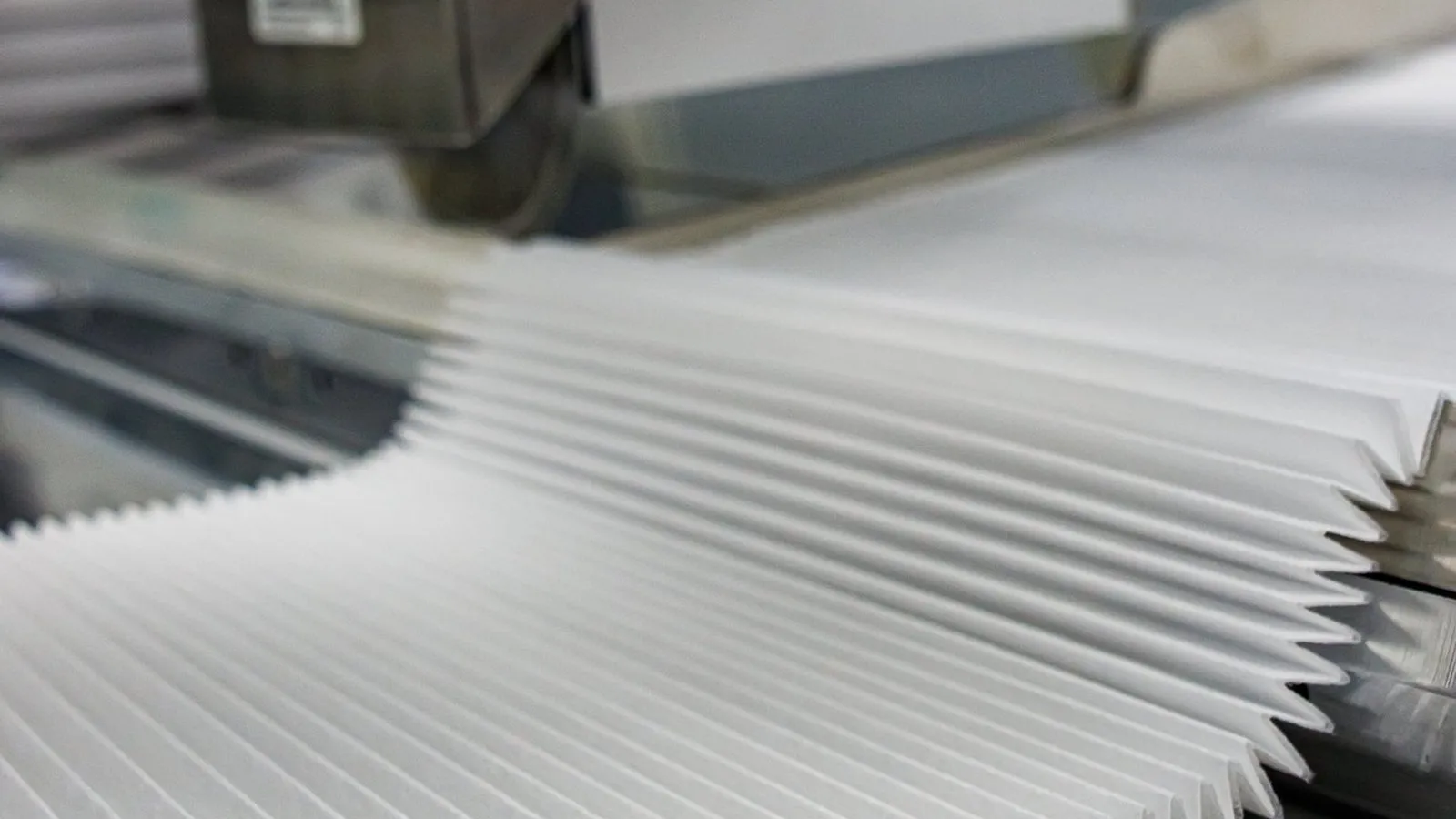
Prefiltration is the stage that retains, ahead of the final filter, the particles, colloids, and part of the bioburden that would otherwise clog it. Its job is to protect the final filter: only what no upstream stage can retain should reach the membrane. Properly sized, it lets the final filter process more liters between change-outs and lowers the cost per liter filtered.
The final filter is usually the most expensive element in the train and the one that defines product quality: a sterilizing-grade membrane, a membrane that stabilizes a beverage before filling, or a polishing cartridge. If it clogs with solids that a prefilter could have retained, you pay twice: in cartridges and in line stoppages.
Why prefiltration determines the life of the final filter
A membrane retains by size, with a narrow pore size distribution. That is why it is precise, and also why it clogs: the particles and colloids that reach it stay on the membrane, block pores, and the differential pressure (ΔP) rises to the change-out value. The LifePure Plus F&B, for example, is changed at 2 bar ΔP. The volume filtered up to that point is its real throughput in that fluid.
A depth medium works differently: it traps particles and colloids throughout its thickness. It has more holding capacity per cartridge and less precise retention. Prefiltration combines the two: the depth or pleated medium takes the coarse load and the final membrane does the fine work.
The cost per liter filtered is calculated by adding up what is spent on cartridges for all stages, on sanitizations, and on downtime hours for change-outs, and dividing it by the volume that passes between one change-out and the next. Prefiltration does not lower the price of any cartridge: it increases the denominator.
Depth, pleated, or hybrid: how each medium retains
Glass microfiber
Glass microfiber forms a matrix of very fine fibers that retains particles and colloids throughout its thickness. The MicroFiber line uses it in three ways:
- MicroFiber Plus: one graded-density layer, from 0.45 to 40 µm, with 0.8 m² per 10″.
- MicroFiber Protec: two layers in series, a more open outer layer and a finer inner layer, from 0.45 to 20 µm, for fluids with a high colloidal load.
- MicroFiber Max: a high-density glass prefilter and a final retention layer, from 0.45 to 1.2 µm, designed as a prefilter for 0.2 and 0.45 µm membranes.
Polypropylene and steel mesh
Pleating the medium multiplies the filtration area within the same 2.75″ diameter cartridge: the ProFlow Plus reaches 8,000 cm² per 10″. ProFlow cartridges use polypropylene microfibers with progressive porosity and are 100% polypropylene, thermally bonded, with no additives or surfactants. The dual-layer versions, ProFlow and ProFlow Protec, combine a prefilter and a final layer in the same element: they start with a higher clean ΔP, but take longer and pass more volume before reaching the change-out pressure.
Stainless steel mesh covers the other end of the range. The MicroMesh uses pleated 304 stainless steel mesh, from 12 to 500 µm, heat-welded to its polypropylene components without adhesives, and withstands repeated cleaning. It works as the first barrier for coarse solids, ahead of the finer prefilters.
Hybrids and dual-layer membranes
PreFiber cartridges combine an upstream depth medium and a polyethersulfone (PES) membrane as the final filter in a single cartridge:
- Pleated polypropylene depth medium + PES: PreFiber PP + PES and PreFiber A PP + PES, with 6,700 cm² per 10″.
- Glass microfiber + asymmetric PES: PreFiber GF + PES, with high-capacity glass and 6,700 cm² per 10″, and PreFiber Max GF + PES, with high-density glass for heavy particle and colloid loads and 4,500 cm² per 10″.
One step further is the dual-layer membrane. The LifePure Protec has two layers of asymmetric PES: the first, with open pores, retains the larger contaminants and protects the second, which defines the rating. Its catalog specifies it for heavy-load prefiltration ahead of sterilizing-grade filters.
Nominal and absolute ratings: what each one means
A micron figure without qualification says little. An absolute rating indicates that the medium retains, with a defined and tested efficiency, all particles equal to or larger than the declared rating. A nominal rating is a size reference without that commitment: some particles of that size can pass. A 1 µm nominal cartridge and a 1 µm absolute cartridge are not interchangeable.
Efficiency is expressed as the beta ratio (β), the ratio between the particles of a given size upstream and downstream of the filter. A β of 1,000 is equivalent to retaining 99.9% of those particles.
What each catalog declares:
- ProFlow Plus: ratings from 0.2 to 40 µm, with absolute retention declared for the 0.5 to 20 µm ratings: 99.9% efficiency (Beta 1000) for particles of the pore size.
- ProFlow Protec: absolute retention in all its ratings, from 0.2 to 10 µm.
- PreFiber A PP + PES: absolute ratings from 0.1 to 1.2 µm, with the prefilter pore size declared for each one, from 0.5 to 3 µm.
- PreFiber PP + PES (0.1 to 0.65 µm) and PreFiber Max GF + PES (0.1 to 0.6 µm): nominal ratings.
When a catalog does not qualify the rating, the safe way to compare is a trial with the actual fluid. For the final membrane filter, the rating is also defined differently, with a bacterial challenge, as we explain in sterilizing filtration: what 0.2 µm means.
How to size the step between prefilter and final filter
There is no pore size ratio that works for every fluid, but there are criteria for staging the steps:
- Start from what comes in. Turbidity, suspended solids, colloids, bioburden, volume per batch, flow rate, and available ΔP in the line. An already clarified wine and a protein solution call for different trains even if the final filter has the same pore size.
- Each stage should retain what would clog the next. If the step is too large—a very open prefilter ahead of a fine membrane—the intermediate fraction passes through and clogs the membrane. If it is too small, the prefilter does the membrane’s job and clogs first.
- Look for balance. The train is properly sized when the stages reach their change-out ΔP in comparable times. If the prefilter is changed much more often than the membrane, it is too tight or lacks area; if the membrane clogs first, the prefilter is too open or an intermediate stage is missing.
- Use dual-layer cartridges when the step is large. Dual-layer cartridges show how staging works within a single element: the LifePure Protec combines a 0.2 µm final layer with a 0.6 µm prefilter layer, and the PreFiber A PP + PES declares a 0.7 µm prefilter for its 0.2 µm rating.
- Measure. A small-scale trial with the actual fluid, recording ΔP against volume filtered for each candidate combination, makes it possible to scale up by filtration area. In operation, a pressure gauge at the inlet and another at the outlet of each housing show which stage is taking the load.
Which prefilter to choose for each fluid
The table organizes our prefilter cartridges by need, with the data declared in each model’s catalog.
| Need | Medium | Model | Catalog data |
|---|---|---|---|
| Coarse filtration of large solids with a medium that withstands repeated cleaning | Pleated 304 stainless steel mesh | MicroMesh | 12 to 500 µm; heat-welded, no adhesives |
| General prefiltration and reverse osmosis pretreatment | Pleated polypropylene | ProFlow Plus | Absolute from 0.5 to 20 µm (99.9%, Beta 1000); 8,000 cm² per 10″ |
| Heavily loaded fluids, with more volume before change-out | Dual-layer pleated polypropylene | ProFlow Protec · ProFlow | ProFlow Protec: absolute from 0.2 to 10 µm · ProFlow: 0.45 to 3 µm |
| Turbidity and colloids ahead of the membrane | Glass microfiber | MicroFiber Plus · MicroFiber Protec · MicroFiber Max | 0.45 to 40 µm · 0.45 to 20 µm in two layers · 0.45 to 1.2 µm |
| Reducing the bioburden that reaches the final filter | Polypropylene + PES membrane | PreFiber PP + PES · PreFiber A PP + PES | PreFiber PP + PES: 0.1 to 0.65 µm nominal · PreFiber A PP + PES: 0.1 to 1.2 µm absolute |
| Proteins, colloids, and high loads ahead of the sterilizing-grade filter | Glass microfiber + asymmetric PES | PreFiber GF + PES · PreFiber Max GF + PES | PreFiber GF + PES: 6,700 cm² per 10″ · PreFiber Max GF + PES: high-density glass, 4,500 cm² |
| High particle load or bioburden, with an integrated membrane prefilter | Dual-layer PES membrane | LifePure Protec | From 0.1 + 0.4 µm to 0.65 + 1.2 µm (final layer + prefilter) |
In pharmaceuticals and biotech, the PreFiber PP + PES is designed for protein solutions, sera, vaccines, and culture media, and the MicroFiber Max as a prefilter for 0.2 and 0.45 µm membranes; the complete train is on our filtration for pharma and biotech page. In beverages and wine, ProFlow, MicroFiber, and PreFiber work upstream of the final membrane, as we describe in wine filtration step by step. In water, all three ProFlow models include reverse osmosis pretreatment among their applications.
How we help you size your prefiltration
We manufacture prefilter and membrane cartridges in Argentina and configure them by ordering code: rating, length from 10″ to 40″, adapter, and gasket material. If you tell us what fluid you filter, at what flow rate and volume, and which final filter you want to protect, we will propose a staged train and the cartridges to test it on your line. Send us your process data.
Frequently asked questions
Can a prefilter with a membrane replace the final filter?
No. PreFiber cartridges end in a PES membrane, but they are installed to reduce the load reaching the final filter, not to replace it. The retention required for the product, such as that of a sterilizing-grade filter, is provided by the final filter with its own integrity test.
Can prefilters be sanitized and reused?
It depends on the model. The PreFiber PP + PES, for example, withstands multiple cycles of hot water at 80 °C, cleaning and disinfection chemicals, and steam at 121 °C, and its catalog declares it reusable. For the cartridges in this article, steam and hot water are specified for single open-end configurations (B to E).
When should a prefilter be changed?
Based on differential pressure, not on a calendar. The ProFlow and PreFiber catalogs set change-out at 2 bar ΔP. If the ΔP drops suddenly, however, a cartridge may be damaged or poorly seated in the housing: check the assembly before you continue filtering.


